

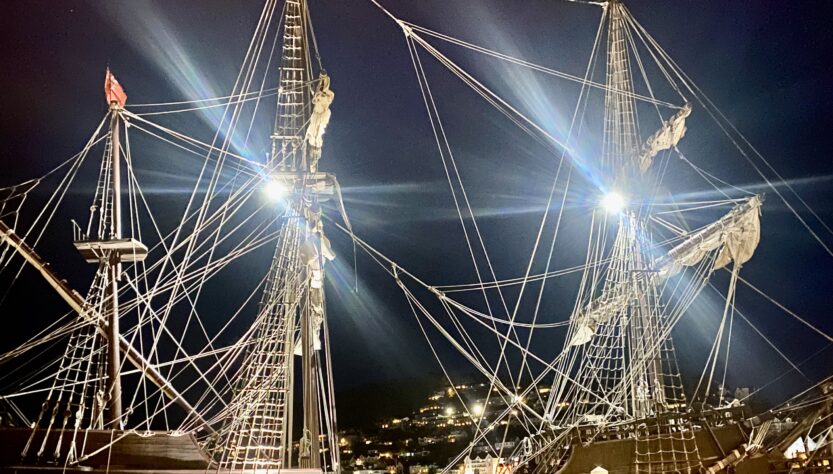
Below is my snippet of Snap Chat as El Galeon Andalucia sailed towards her mooring.
Dartmouth’s Community has been treated to the arrival of El Galeon this weekend. The replica 16th Century Spanish galleon sailed into the Dart on Friday. She truly is an awe inspiring vessel. And her secrets are open to the public all weekend until she departs on Monday.
 This is the only vessel of its kind that sails the world. She was built in Huelva, Spain , in 2009 and her masts were installed to completion in 2010.
A floating museum, she gives visitors the experience of life on board in the 16th to 17th century.
El Galeon was funded by the Nao Victoria foundation in Spain. They support the construction of replica vessels like El Galeon and preserve the history of these magnificent ships. She has travelled more than 50,000 miles to date, crossing , amongst others, the Pacific , Indian and Atlantic oceans, the South China Sea, and ports around the world. It is a privilege to see her pull up in Dartmouth.
Huge Galleons such as these lie around 50 m long. They would carry between 500 and 1200 tonnes of goods, together with crew, merchants, families, other passengers and even livestock. Crew had various duties including watches overnight. And 18 were needed to haul the main sail!
 Vessels would sail as part of a flotilla , or fleet , of 10 – 30 boats between Spain, America and the Philippines . A convoy would give safety in numbers and army ships were their escorts.
Goods moved between ports – wheat, olive oil , wine and fabrics left spain; American and Philippino goods returned like potatoes, and particularly gold, silk , ivory and silk – a great attraction to pirates.
The Galeons opened up the world and for the first time connected different continents.
Standing next to El Galeon on Dartmouth’s harbourside I was struck by the complexity of the ropes and rigging, platforms like crows’ nests , the bulbous shape of her hull and the cannons that lined the deck. Today she is an incredible thing of beauty.
But history tells us life on board was tough and many crew members lost their lives at sea on their arduous 16th Century sea journeys.