


Credit to this Devon Zoo for successfully hatching a rare dinosaur bird!

In a week when we’ve heard of the financial challenges that Paignton Zoo faces, lets tell the good news of the endangered cassowaries they look after. Learn about one tick for conservation success from an Institution that must be preserved.
So , a Cassowary, you ask? Well think Emu or Rhea . The Cassowary is a huge, flightless, runner bird, around 2 metres tall, that sprints up to 30 mph and originated in the Australian and New Guinea rainforests. An endangered species, its commonly thought of as one of the world’s most dangerous birds, with its ancestry still closely linked to dinosaurs.
Residing at Paignton Zoo is 16 year old Madrid, a handsome male sporting his characteristic helmet-like
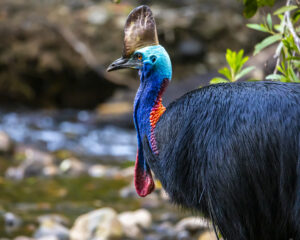
headwear, or “casque”. Madrid arrived in 2007 . A neighbour in the form of a female, Twiggy, joined the Zoo in 2017 . A younger girl, she is just 11 years old. The two birds had lived side by side in adjacent enclosures for some years. So the path had been laid for a face to face meeting earlier this year .
Sometimes close introduction can spark aggression and fighting amongst pairs. The concern is heightened by the fact that these birds have strong toes with sharp claws. – so sharp that they can use them to inflict lethal damage.
But these 2 got on like a house on fire. Keepers were hopeful that , just maybe, they may successfully breed.
Visitors have long been fascinated by cassowaries, given their huge size, distinctive horny headwear, black feathery bodies and colourful faces with blue heads and bright pink, dangly wattles . There is debate as to what the shell like casque does to help survival – generally its thought to be important for body temperature regulation – like an intricate radiator on top of the bird’s head. But then others suggest the casque helps amplify sounds like an elaborate hearing aid.
Well , day one of introductions went well and these two enormous birds were observed to mate several times. That lead to some optimism amongst the keepers. Fingers were crossed for additions to the family.

And then, in August 2025, came the excited Zoo announcement that a chick had successfully hatched. After a 50 day incubation time, the new arrival was the first at Paignton for 21 years. And , indeed, it is considered to be the only Cassowary hatched in Europe in 2025. These birds are so rare in Northern hemisphere captivity.
Occasionally other Parks and Zoos report a successful cassowary hatch. But all mention the difficulties of conservation here, due to the particular behaviour and lifestyle requirements these birds enjoy.
Well this is a modern day bird family, not doing the conventional rearing we may expect. No! Our handsome little chick will be raised by Dad. Dad even did the incubating too. In the wild, cassowary males assume all the parenting duties. This is what we’re witnessing in Paignton. So its Dad all the way for the next 18 months.
Our little stripey, odd looking, humbug-like fellow follows Dad around for protection and tips on best places to feed.

Australian Southern Cassowaries are endangered in their native home environments – environmental change is, of course , a factor. But other man made threats have appeared – deaths from cleared habitats, dog fights and vehicle strikes have had an impact upon numbers.
Authorities want to keep the birds “wild”. Naturally shy, the birds would rather avoid human interaction. They generally only become aggressive when defending their nests. Yet they are known to have been hand tamed and hand fed – early reports describe these birds as being kept as pets , or domesticated, particularly in New Guinea . Here the desire was mainly for egg production and rarely meat.
Urbanised birds in Queensland , Australia, have been known to raid picnic baskets and bird feeders. Let alone mistakenly eating pieces of lego, and even roadkill. But in the wild they are cautious – hunting dogs, for example, would be wise to avoid these guys. Occasionally a chick is taken , but more often the predator can be killed by the actions of the disturbed adult male minder. Dangerous guys.
Now the Australian government declares it illegal to feed cassowaries and they must not be encouraged into domestic situations, – in attempts to preserve the wild population, which is in decline..
So the Dad’s in charge? Well that is the situation here – most birds co-parent and share the jobs. But just 1% of bird species have the male- only parent. Cassowaries are one of the bunch. Quite a few runner birds do this. Some folks even say that’s what some dinosaurs did. But who knows that one?!
They are pretty sneaky creatures – shyly they can observe humans and slip away long before anyone notices. Their wings are small and just able to flap a bit. And for body feathers – think emu – type, floppy soft feathers and no tail feathers. They have small beaks and no tongue, adapted to pick up small berries. They feed on berries and fruit and are so well adapted that they can deal with fruit stones that contain cyanide-like poisons with no ill effects.

And cassowaries are designed to run; powerful legs, three toed feet and sharp claws. Golly can they kick – and with precision too.
The girls? Well Twiggy follows the species’ normal behaviour and didnt care for the egg she laid. Much like the girls in the wild – After a rather ritual mating, any egg that is laid is disgarded by the females and they move around in the wild to lay eggs in other nests too.
And in Paignton , like in the wild, our cassowary girl is happy to live a solitary life once more.