


Explaining how the famous red shirted bear with links to Dartmouth crossed the Pond and is now considered an American bear.
Well the situation is complex.

A.A. Milne created the stories of Christopher Robin; a small boy with his beloved bear, Winnie-the-Pooh. Fictional Christopher Robin was based upon Milne’s own son and the cuddly bear bought for Christopher’s first Birthday in 1921. The Birthday bear was bought from Harrods , and named Edward Bear, before a later name change to Winnie. And the name Winnie came from a female black bear cub that had been brought to London Zoo from Winnipeg in Canada.
A.A. Milne devised the tales of this little boy and his toy bear’s adventures for his own son – a wealth of stories of Pooh and friends from the Hundred Aker Wood – inspired by 500 Acres in Ashdown Forest in East Sussex where the family lived. More toys joined the stories – Piglet, Eeyore, Tigger and Roo.
It seemed idyllic – Christopher Robin Milne’s toys were the subjects of his father’s books. The situation snow-balled and the little boy became famous in his own right and really quite enjoyed being noticed until he reached the age of 8 or 9.
The story was to turn full circle, however. Christopher Milne came to resent the success of the Winnie-the-Pooh stories. His father was taken up with the incredible success; the story telling took Christopher’s father away for long periods. Four main stories were created over 1924 to 1928. Illustrators and Publishers were engaged . Milne was a busy guy. But in his shadow, young Christopher was having a miserable time – no father figure at home, sent to boarding school and bullied.
Over time, son Christopher Milne came to resent the little yellow bear.

It was many years later that Christopher Milne confessed he cared little for Pooh , or indeed his father – feeling that Mr Milne had climbed to success on the shoulders of his son , leaving the young man feeling empty and fairly useless by comparison.
And here we are, in the throws of success of Winnie-the-Pooh. The first newspaper story appeared on Christmas Eve in 1925. E.H Shepherd illustrated the text.
More storybook tales were born.

Milne had engaged a publisher, one E.P.Dutton , who took on the task of promoting the author’s literary work. Business continued and having seen the toys himself, Dutton suggested a promotional tour to the states . It was 1947 when the original Winnie-the-Pooh and friends were loaned to tour America. Well all except “Roo” , who had been lost some years previously in the Milne household.
And so, in 1947, when Christopher was 27, all his old toys were touring the states under the stewardship of Dutton.
A.A.Milne was also thinking about Marketing. In 1930 he had signed a contract for the rights with Stephen Slesinger for just $1000. And the merchandise started flowing freely, in many directions, under Slesinger. At Slesinger’s death in 1953, his wife Shirley took over merchandising rights and promoting the brand.
Back with Mr Dutton, – he kept hold of Winnie and the other toys , displaying them in his offices, but then latterly in the New York Library. It was 1956, when A.A. Milne died, that E.P.Dutton brought the bears from the author’s estate for $2500. He subsequently donated the little creatures to the Library. And they have spent most of their time since that date in various New York locations.
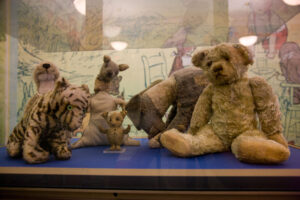
Currently the toy pals have a swanky new home in the Stephen A. Schwarzman Building on 5th Avenue, New York, where they are housed in glass cabinets in climate controlled conditions.
But back to the marketing of Winnie-the-Pooh . Well Shirley Slesinger was approached by Walt Disney in 1961 for marketing rights. Literary rights had stayed with a trust set up by Milne – the Pooh Properties Trust.
Marketing rights for Pooh bear were sold to Disney after that phone call and Shirley retained a strong income from the royalties that flowed for many years. Some royalties also flowed back from Disney to the Pooh Properties Trust . That was fortuitous since some of this money filtered back to Christopher Robin Milne and his daughter, Clare.
Under Disney’s umbrella, the income from Winnie the Pooh rolled in – merchandising opportunities, then a short film in 1966 about Pooh and the
 Honey Tree. Next came other features – think a Blustery Day and Tigger Too, before a regular TV series. Billions of dollars were generated.
Stateside Winne-the-Pooh and friends required ongoing conservation and upkeep – for a year in 1987/88 during time at the New York library their cuddly shapes were renovated. And again in 2015/2016 when the toys had moved to their new display venue. Conservation repaired many flaws using the newer techniques that were ever evolving in the preservation world. The flattened thread bear limbs of Pooh were repaired, limbs of the little creatures were reinforced and straightened , fur was preserved and features like Eeyore’s eye patches and Pooh’s nose were repaired by textile conservators. Preserving the twists of historical wear and tear had become possible.

If we go back to Christopher Robin and his life estranged from his parents. University life at Cambridge and war time had passed and Christopher married his first cousin, Lesley in 1948. They moved to Devon to escape the links with Mr Milne Senior, and Winnie-the-Pooh. Christopher sought a life away from the limelight.
The young couple made a home in Stoke Fleming in Devon, putting down roots in 1951. And the Milnes famously ran the Harbour Bookshop in Dartmouth – now the Whistle Fish Gallery – on Lower Street, where Christopher was a well thought of member of the town. He was remembered as somewhat shy of any publicity. Quiet and gentle, he walked slightly stooped and wore owl rimmed glasses.

The bookshop was Christopher’s business for over 30 years. People came to know that he was the inspiration for his father’s work. However, that had come to be a very uncomfortable association. Christopher would often hide in the back of the shop when people came to enquire, leaving staff to say he wasn’t at the shop that day.
Back in the states, there was word that some Brits campaigned for the return of Pooh bear and friends back to the UK. This was 1998 when British MP, Gwyneth Dunwoody, even tried to intervene in the argument. She considered Pooh and his friends to be America’s Elgin Marbles and should be returned to the UK. To no avail! – The “dispute” made the front page of the New York Post, and prompted comments from then Mayor, Rudi Guiliani. But Tony Blair’s intervention withdrew the plea and saved the special relationship with America

In the 1980s, Christopher Milne spoke with Gyles Brandreth- he had been estranged from both parents in their later years, until their deaths in 1956. A lot due to his wife Lesley, who didn’t like the in-laws. But Christopher did come to terms with it and even came back to liking Pooh and spoke of contentment in his later life.
Christopher and Lesley had a daughter, Clare, who lived with Cerebral Palsy. Despite the anxiety Christopher had felt for most of his life towards his father and Pooh, the royalties that came back through Pooh’s Properties Trust proved helpful, particularly to the care costs for Clare. So much so that a charity trust to this cause exists to this day.
In 1996, Christopher Robin , the famous little boy with the bear, died in his sleep . He was 75. After many decades he had made peace with his father’s legacy and was content that Pooh and his friends stayed in America.