



Sat in a deckchair, casually watching a game of cricket on the village green is a quintessentially British way to spend a summer afternoon; the thud of leather on willow, and spectators at the boundary politely clapping opposing teams as they jocky for control of the cricket pitch.
Well so you would imagine !
But on the Devon/ Cornwall border a rather different game of cricket took place. And good old eccentric, British, rivalry played out before the tide came in.
It was 2016 and local man, Mike Tucker, threw down the gauntlet for an unusual game on the River Tamar.
A team from the Saltash based Cargreen Yacht Club – the Cornish boys – laid down the challenge to a Devon Team across the River Tamar. And, from the Devon side of the river, the Weir Sailing Yacht Club sportingly agreed to play.

The venue was the mudflats that appeared on the bed of the River Tamar, at exceptionally low tides, on this once in a decade low tide. And so the pitch rose out of the River Tamar at Weir Quay , just upstream from Halton Quay.
The Teams gathered on a fairly sunny Summer’s day with a pre match BBQ. Both teams and the Cornish Wreckers Morris Men were escorted to the pitch. Those Cornish Morris Men danced strategically and blessed the pitch surface.
And then it was all systems go!
The match began at a pace, its only constraint being the returning tide that wanted to lap around the players’ feet and bury the pitch. Players hit the ball with water sloshing around their knees, the wicket was sinking under the waves and the best runs were made before waves covered the pitch for the runners.

Michael Tucker had brought in a few unique rules , with fielding proving interesting – the fielders were now called paddlers and able to stomp through the water up to welly height. The outer fielders had to cover the deeper water in boats and were sportingly able to catch from the boats. No runs could be scored if the ball was hit into the reeds.
Team Weir Quay did employ an extra fielder in the shape of a retriever dog . He proved great for the retrieve but tended to run off with the ball rather than hand it over for stumping.
You can imagine the crazy entertainment on the day and laughter so much that your sides would split!
The tide was the game controller and as the water started to flood back in , the game came to an end.
The score? 42 to Cargreen and MINUS 16 to Weir Quay , by virtue of the strange watery pitch rules. The Cornish boys were the certain winners.
A high stakes prize for the winning team was to choose how the Afternoon Tea scones were taken – jam first of course in honour of the Cornish winners.
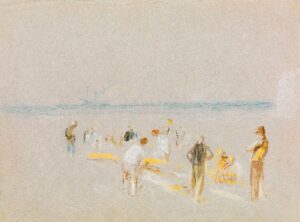
Such a great match location – but the River Tamar is not the only British coastal sandbank cricket location. Famously there is Goodwin Sands , a 16 km length of shifting sandbanks just off Deal on the Kent coast. These sandbanks are visible for the longest periods at the Spring and Autumn equinoxes and have even been known to cause hazards to shipping. The first cricket match was played here in 1813. A chalk drawing by JMW Turner is in circulation, documenting a match he watched there around 1830.

Another coastal site is the smaller Bramble Bank off the Solent, nestled between the mouth of Southampton water and Cowes on the Isle of Wight. It too holds regular matches. Once more it is a match between opposing Sailing Clubs – and in gentlemanly fashion, the match winners are prechosen and alternate year on year. It keeps it all friendly ! The bank becomes exposed for around one hour. Allowing may be 6 or 7 hurried overs per side, amongst great hilarity. Aside from the matches at the equinoxes, this smaller sandbank has also proved a shipping hazard, with the QE II famously running aground on it in 2008.
But the Tamar cricket was a once in a decade event.

Sandbanks and mudflats have their own ecological role – made of fine silt that moves with the tides, they soften the rigid delineations between the sea and the coast. In some cases the areas can incorporate unique fishing grounds, located often upstream of the banks, they can be natural surf breaks or diving spots. Wildlife lives in and around the mud flat. And it also serves in a key role to filter and improve water quality. Sand and mudflats remain a sign of a healthy estuary.
But, today, some old fashioned English eccentricity of cricket on the hidden Tamar territory grabbed our attention.