


By pure chance – research into how to improve the catch of Crabs and Lobsters led to a fortuitous discovery…..
The advent of Disco Scallops. It was 2022. Devon Scientist, Rob Enever, was working on this Crab Pot project at Totnes based Fishtek Marine. He put the pieces of an unusual jigsaw together and quickly put Disco Scallops on the map.

Historically there has been a long and continuous drive to make fishing and seafood harvest sustainable; a lot of fishing boats that dredge the seabed for their catch are known to be highly destructive to the ecosystem that lives on the seafloor……..
The Secret is crab pot lights. Rob’s brief was to find solutions to improve fishing performance – here ideas to better harvest crab and lobster whilst protecting fish stocks. ……
And so his research led to the concept of illuminating crab and lobster pots to see whether light attracted more of those species to enter. Pots were set up with battery operated LED lights that shone brightly in the murky waters. And trials began. The team waited to see if catch numbers of crabs and lobsters were higher.
The lighting was a big fat fail for higher yields. But something exciting happened
Rarely do fishermen find scallops in their crab pot catches. But scallops started arriving. Fishermen in several locations reported significant numbers of scallops harvested in their illuminated crab pot catches. And these scallops became a welcome boost to the value of the catch brought back to shore.
Sustainable scallop fishing The traditional way to catch scallops is by seabed dredging – 95% are caught this way, with a back drop of massive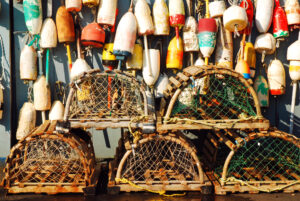 ecological destruction.
A tiny percentage of scallops are hand dived – sustainable , selective and eco friendly, but costly and at high risk to the diver in many weathers.
Suddenly, here was a new player on the scene – scallops in the illuminated Crab pot. And the phenomenon needed investigation.

Dr Robert Enever and his team.. The Fishtek marine team investigated the theory, working with pot makers ( who modified the ramps on the pots) and Exeter University and fishermen around the country. Fishermen like Newlyn based Jon Ashworth. Sure enough, numbers of European King scallops entering the illuminated pots were high.
In a series of experiments, 1886 pots were hauled- 985 included lights. And there was no doubt about their findings; 518 scallops in the lit up pots, against just 2 in the 901 pots that had been lowered with no lights within.
Green Light. Dr Enever spent time trying to discover why the light attracted the scallops into the pots so relatively easily. His theory is the LED lights illuminate the plankton organisms in the water. Green light seemed more effective than white. Rob felt that maybe sitting under the light means the scallops , with their 200 eyes, can detect the highlighted plankton more easily, and so optimise their feeding.
The project moved on looking at lots of scallop testing variations – like how strong the lights should be, whether the lights should flash and the pot and trap door design too.
With optimal design, the scallop retention rate across all the hauled up pots was 2 scallops per pot. The maximum number of scallops averaged 26 per pot.
Back at the lab, Rob and his team set up recirculated tanks to study the scallops more intensely. Individual scallops could be constantly followed – entering and leaving the pots to fine tune the desirable fishing characteristics. They found that scallops were exceedingly accurate swimmers.
Save on the bait! Out in the oceans, Fishermen like Jon Hays , based out of Falmouth , took part in the Devon laboratory scallop trials – and Jon now finds that he is happy to fish for scallops purely using lights and no bait. He leaves the pots down for slightly longer in these scallop areas. When he’s crab fishing, he may lay pots with both bait and lights for success.
Jon says the scallops are happy and growing well in the areas fished and their numbers are consistent.
This illuminated scallop pot fishing has proved a great success.

The Disco Scallop goes commercial. The name of Disco Scallops has emerged – and this Disco is repeatable with those funky scallops heading into the lit up pots every time. In time the fishermen expect scallop prices paid will reflect this high quality, sustainably sourced shellfish.
A big bonus to this new concept are the seafood chefs; these guys now have a sustainable source of quality scallops . Mitch Tonks, our local Devon Chef and entrepreneur now sells “Disco Scallops” in his Restaurants and for home delivery. Their catchy name is great for sales, and quietly pushes the sustainable way of harvesting this shell fish into the reach of ordinary seafood lovers.
Check out the Disco Scallop Collective, who support the Fishing Industry and this clever way to catch scallops

but preserve the Seabed. Their belief in the results is so complete that the Collective encourages commercial fishermen to buy their modified pots from Fishtek, and in return will market the disco scallops they catch. All saving the environment and the sea bed, and helping the fishermen into profit.
Disco Scallops – Surely a Devon win – win story.