


How a cottage on the beach at Salcombe started life as part of the jigsaw of Victorian global submarine communications.
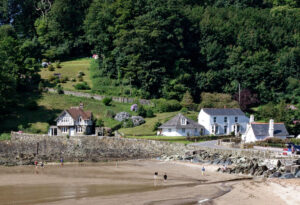
Check out Cable Cottage
Take a stroll from the heart of Salcombe, and following the coastline, you reach North Sands Beach. It’s a pretty little sandy cove, with the beach tumbling away from “The Winking Prawn” restaurant. And just down the road from this pretty little restaurant is Cable Cottage.
Cable Cottage has a great story to tell.
These days guests can holiday at the cottage and enjoy modern comforts. But not many people appreciate the huge part this cottage played in the advancement of our global communications. And the complexity of the global communication cables that sit under the sea.
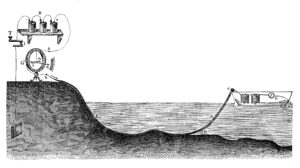
Early years of messaging under the Sea
Submarine communication cables were developed in the 1840s as a means of sending messages across the seas – transatlantic, or maybe just into Europe.
Telegrams were just emerging, thanks to Morse and Wheatstone, who revolutionised land based communications . And now this next stage required great engineering skill to send messages across the water. More specifically – under the sea . Before 1840, the fastest way to send a message across the Atlantic to America was by steamship. After 10 – 12 days, your message would be delivered..
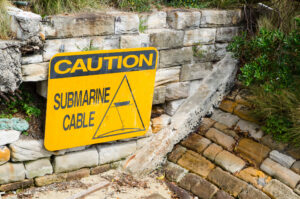
Early success sending messages under water from Dover to Calais.
Well copper wires carried the messages and these were wrapped in a natural latex called gutta percha. Messaging cables were first tested in short stretches , crossing rivers and short stretches of water in the 1840s.
Following good initial success, developers got bolder. And in 1850 made the first attempt to lay a submarine telegraph cable between Dover and Calais. This communication worked, but only for 24 hours, failing since it wasn’t adequately protected.
It didn’t take long for success to follow, however; a stronger, more armoured cable was used, which was better protected by layers of hemp and wire. This was to become the worlds first permanent international submarine cable. And the year was 1851. The next challenge was to lay a cable across the Atlantic.
Calling America

Enter Cyrus West Field, who founded the Atlantic Telegraph Company in 1856. A bigger cable was constructed – 7 copper wires were put together, wrapped in gutta-percha, covered with a tarred hemp and multiple strands of iron wire. It was planned to run from the Irish coast to Heart’s Content in Newfoundland – some 2500 miles.
Amazing to think that the sheer weight of each mile of this cable was 1 tonne. With the lack of sonar and GPS, cable layers relied upon navigational charts for direction and depth – with two ships setting off and essentially meeting mid Atlantic to lay the cables up to 3000 metres deep and then splice the cable together.
It worked !! But not for long.
Queen Victoria sent the first official telegraph to US President James Buchanan on 16 August, 1858. A rousing success! But three weeks later the cable failed. It was a learning curve; poor insulation and too much electrical voltage had burnt out conduction.
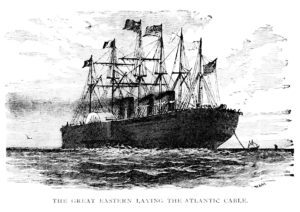
Just seven years later, Isambard Kingdom Brunel’s steamship, SS Great Eastern, came into her own – and carried the entire length of cable that would cross the Atlantic. It amassed to thousands of tonnes of cable. Now there would be no need for a join. The cable was transported in tanks of water to keep the insulation flexible. And it was rolled out off the ship under constant tension along the Atlantic sea floor.
During her first attempt to lay the cable in 1865, the cable snapped in deep water.
A year later the cable was successfully laid. And as a bonus, engineers managed to recover the previously lost cable and reuse that one to completion. Two cables were then running across the Atlantic. Small boats had been used to secure the line on the shoreline. Once hauled onto land, the cable was connected to a telegraph station.
Telegraph transmission time had reduced from 10 days to a few minutes.
Linking Salcombe up
Within Britain , a land based network of telegraph lines spread out, even with lines extending between Totnes and Kingsbridge , linking receiving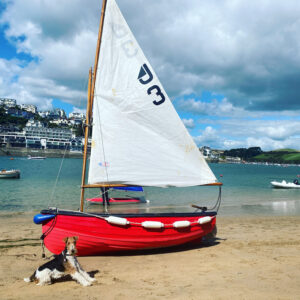 stations. At Prawle, newspaper owner, Mr G.P.Friend, was able to receive early messages of news for his paper, the “Shipping Gazette” by these links. Spider like links on the South West map linked neighbouring areas like Frogmore , and Salcombe. Post Offices like Kingsbridge and Torcross became receiving offices for messages.
Cable Cottage in Salcombe was one such telegraph station when her route was engineered.
And so to Cable Cottage
Cable Cottage enters the story in 1870. It was built on the edge of Salcombe’s North Sands Beach as one of the landing stations for a cable to link Britain with France – the Brest-Salcombe cable, which spanned a distance of 101 miles. From here the cable could be monitored, relays could boost the signals and the operators could live on site.
The Salcombe link was a significant landing point and meant that now messages could be fired off to and from London or Paris and then eventually on to cross the Atlantic.
To accomplish the laying of the Salcombe cable, a steamer ship ,the William Cory, arrived off Salcombe on 27 May 1870, with the shore end of the cable , selecting a landing point on the beach just under Bolt Head. The cable was taken 250 yds to the cliff top, to a temporary testing house, before relocating into a more permanent building.
A different ship, the Anglo – American “ Robert Lowe” was the one that subsequently helped raise the shoreline end of the cable so it could make a fresh splice to Cable Cottage on 15 October, 1871.
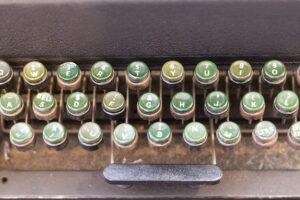
Operators in the Cottage had to monitor the cable for continuity and insulation of the submerged portions. This important link connected Britain to Brest, in France . And then from Brest came the link to Cape Cod, USA
Such great things followed – within 40 years , there were over 100 submarine cables linking the continents. And just fifty years later the first transatlantic telephone service started.
Now a days, hundreds of fibreoptic cables carry 99% of the world’s internet traffic . So valuable is this communication resource, that it requires constant protection from damage and sabotage, by alien forces.
Now a holiday home
 The Salcombe Cable became defunct in 1900, when it was replaced by a different cable across the channel. And Cable Cottage was converted to residential use.
Today Cable Cottage is a popular holiday rental property and worth a discovery. From its historical start as a submarine cable landing point, it was substantially renovated. It spent a short time as a café, before becoming residential. There remain several features that hint of the past – like the arched windows and wooden mullions.
And this pretty little Cottage quietly still tells a great story of global communications in Victorian times .