


HMP Dartmoor Prison lurks on Dartmoor at Princetown.
Dartmoor Prison is such a notable landmark in crime novels of our famous sleuth, Sherlock Holmes.
Holmes and Dr. Watson have covered the ground around Dartmoor’s “Princetown Prison” more than once in their investigations.
Sir Arthur Conan Doyle made reference to the prison in his Sherlock Holmes novel “The Hound of the Baskervilles”, centred around Dartmoor and a prisoner escape. He is said to have heard ghost tales about the “yeth” or “yell” hounds on Dartmoor when he stayed in Princetown.
Further inspiration was the tale of 17th Century Squire Cabell – who hunted a pack of black hounds and was said to have murdered his wife. On his death, legend said a pack of black hounds ran howling across Dartmoor. Cabell is buried in Buckfastleigh and his tomb is sealed to stop his ghost riding out with his hounds .
In the famous novel, “The Hound of the Baskervilles”, Cabell was the model for Sir Hugo Baskerville – the source of the family curse. Conan Doyle wrote descriptively about the moors, particularly the sounds at night, the prison itself, and a large mastiff type dog , painted in Phosphor and kept half starved by his master, who roved the moors and killed members of the Baskerville family.
The plot line brings in Selden , a prisoner who manages to escape Dartmoor Prison, only later to be killed by the hound on the moor as the plot thickens.
Sadly I’ve never been fortunate to see Princetown in the sunshine . Sitting high on Dartmoor at 1400 feet above sea-level, it’s always been wrapped in low mist and dizzle, that smothers you as you climb the moors from Ashburton. The black outline of the prison was hiding in the mist behind the trees when I visited this week
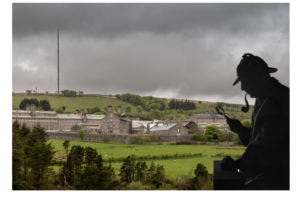 Setting HMP Dartmoor at Princetown always seemed somewhat creepy- even the granite outline through the mist has an eerie feel about it. But that just adds to the atmospheric writings of the many authors, including Conan Doyle.
In today’s times, Dartmoor prison is a Category C prison, standing on Duchy of Cornwall land – suitable for non violent and white collar prisoners, and currently houses around 659 inmates.
There is even a museum on site with clothing, uniforms and weapons of prisoners past, together with goods made by current prisoners.
The original prison, designed by Daniel Asher Alexander, opened in 1809, laid out within a high, circular granite boundary wall. Local stone boulders were broken to make stones for building, supplemented by dressed stone from Herne Hole quarry nearby.
If our prisoner ever managed to escape, the prison location is tens of miles from anywhere , with moorland and bogs and extreme weathers.
However the notion of a prison first started in 1805. The original floating prison ships at the time were no longer appropriate; derelict ships had been moored near Plymouth, to house prisoners from the Napoleonic Wars with France. Conditions were appalling and so a remote location was chosen – hence on top of Dartmoor- to construct a “war depot” – with “fresh Dartmoor air”.

French prisoners arrived in 1809, joined by American seamen POWs in 1812, swelling numbers at one point to an eye watering 6500. Conditions were poor with dramatic outbreaks of typhoid, smallpox and pneumonia. There were mass deaths of 1500 men , or so, before repatriations of prisoners began in 1815, when the wars had ceased. Those dead were buried on the moor.
After this evacuation of 1815, the prison stood empty until 1850, when it was repurposed as a gaol. It ran pretty much in this form until 1920. The prison even housed conscientious objectors – “Conchies” – from WW1 for a few years. These men were forced to bring their families to this government labour camp as an alternative to avoiding combat. They were despised by the community and had a miserable time.

The locks came back on , however in the 1920’s to admit criminals with long term sentences .
There have been several notorious prisoners within its walls over the decades since that time. Serious offenders like Jack “ the Hat” McVitie and Frank Mitchell have been inmates. Many attempts to escape are well known .
In 1987 the prison was given Grade II heritage status. To this day this historic landmark retains a prison population within its dark walls.
Maybe the legendary Hounds still patrol the moors at night.
Who knows on that one ?!..