

- Drinking Proper tea in China Teacups, sat in the Parlour!
I wandered around Ashburton for the first time yesterday – a colourful little town strewn with period properties, pretty cottages, a bank of Antique shops and lots of tea rooms and restaurants.
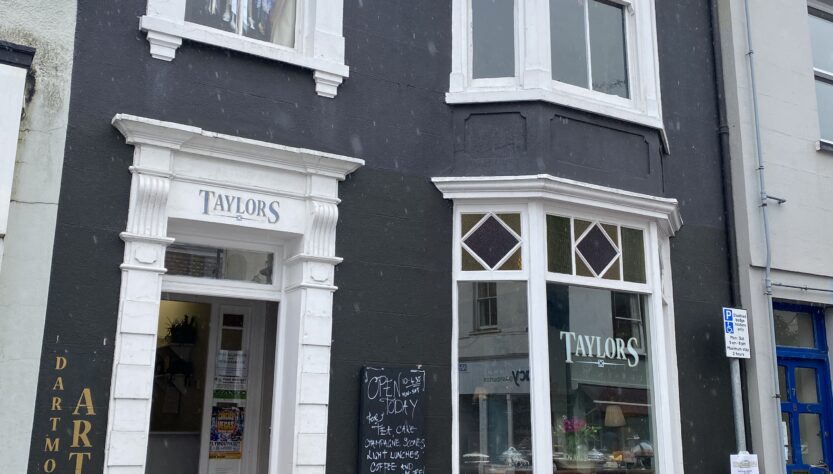
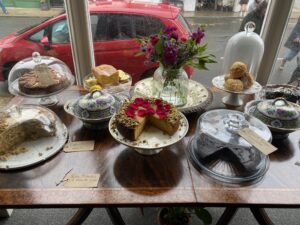
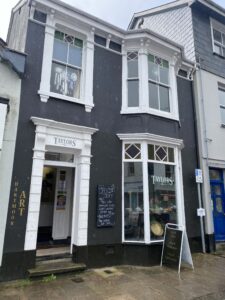 Taylor’s Tea Shop on North Street was so welcoming with its beautiful façade and
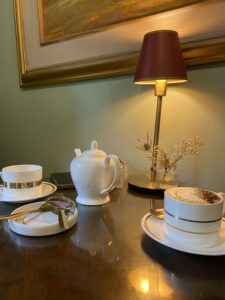 glass domed cake stands in the window. Step inside and you are almost going back in time into a gentleman’s parlour with muted colours, horsehair spring chairs , mahogany tables and old paintings covering the walls
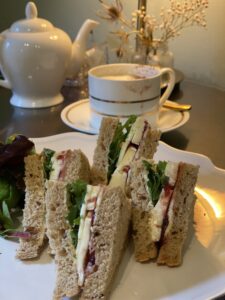
We marvelled at our little find. Such lovely ladies running a great and welcoming eatery. There was an endless choice loose leaf tea served in bone china cups and I have to say such precisely cut sandwiches – they were too good to disturb. The cake display had a choice for everyone .
 The overall joy was my first impressions of what a great little town Ashburton is, with traditional shops, tasteful signs and colours and a whole street of Antique shops too for that Saturday afternoon potter.
I think could put my feet down in Ashburton.
It is a bit of a hidden gem in mid Devon, nestled beside the River Ashburn. It is listed in 1086 in the Domesday book , when a community of families grew up around the Manor house, the residence of the Bishop of Exeter. The Bishops greatly enhanced the town’s developing prosperity. But also the town’s geographical location was key to success; it was accessible to Dartmoor and ideal to capitalise on the mineral wealth through extraction of tin.
And it’s one of four stannary towns – the brown sign even says so as you leave the A38.
So what’s a stannary town?
Well historically there were four stannary towns in Devon. Stemming from the 1300s, these towns had links with the tin trade. There was a small area encompassing Chagford, Plympton , Tavistock and Ashburton – each town being judged properly qualified to assay – weigh, stamp and tax – tin produced from tin mines on Dartmoor.
For a while Ashburton was a boom town with tinners, merchants and royal officials coming to the town.
But local tin and iron and wool trades declined in the 17th Century and so Ashburton made a living with passing trades between Exeter and Plymouth. There were Coaching Inns between the stops. And it’s interesting to see the majority of houses that line the town date from the late 18th and early 19th Centuries.
The railway took trade past the town in 1846 and it seemed somewhat left behind, even though a branch line was laid to the town . The population declined as people moved to Torquay and Newton Abbot. Looking back, may be that was a hidden blessing – lack of funds meant there could be no large-scale redevelopments. Hence few late Victorian and Edwardian buildings were built to change the landscape and it remains trapped in a previous century.
But since the 1950’s Ashburton has seen a quiet revival and really is a thriving hidden gem.
 As you indulge yourself wandering the town , there is such a distinct feel of enthusiastic residents enjoying life and events within this unspoilt little haven.
Call in and may be take tea in Taylors; that little shop has its own history too if you care to enquire
.