

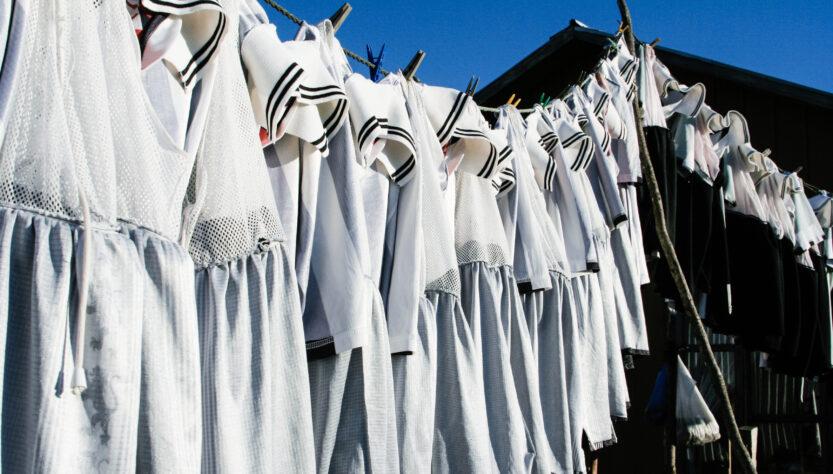
Memories of the laundry and its people, located at the top of Kingswear Creek – that once served the Royal Naval College
I’d heard talk of there once being a huge laundry at Kingswear – the tales of locals being employed and laundry maids happily walking up to the laundry room door once they’d crossed on the lower ferry.

But there is very little information about the industry that once stood at the site of the cluster of houses we now know as Waterhead Close.. History suggests that the site was originally Pope’s Brass and Iron Foundry, before becoming Polybanks Shipbuilders in 1874.
By 1884, George Mitchelmoore had taken over the buildings and created the Laundry, after fire had destroyed his previous Laundry on Dartmouth side.
Thanks to Reg Little, now deceased, and the contribution of his son Rob, the memories of Reg are recorded and his tales of what went on at the laundry won’t be forgotten. There’s even a YouTube recording from Reg talking about life in Kingswear in the 1930s and 40s.
Just a few pictures and sketches exist of a significant red brick building at the

head of the Creek , with its multiple rooms and roof heights and a large brick chimney emerging from the rear of the site. And on the right side of this cluster of buildings were some painted words – “Contractors to the Royal Yacht, Victoria and Albert, HMS Britannia and the Royal Naval College only” – visible for all to see as they walked up from the Square at Kingswear.
This was the “Dartmouth and Kingswear Steam Laundry” – a good business set up in the late 1800s. One of its main contracts was with the BRNC, the Naval College in Dartmouth, training the next generation of naval officers. And at the door a large Coat of Arms declared “By Appointment” – a proud royal connection. Prior to using the services of the Dartmouth and Kingswear Laundry, the Navy was sending its laundry on a 2 week round trip to London.
It was down to Reg Little to document this story of real names and people involved in the work, when he was chatting in 2011. He had personal links to the Laundry since his brother’s wife, Rosamund was the granddaughter of the early manager, Mr John Bell. He was noted in the 1901 census as being a Laundry foreman. The Bell family lived next door in Waterhead Cottages, working for laundry owner, Mr Mitchelmore.

Running a Steam Laundry harnessed early engineering advances – indeed the Laundry was powered by steam engine. The high brick chimney, later replaced with steel, that could be seen, vented the fire which heated the water. And water was supplied from the stream which ran down from Oversteps House , by the nearby cemetery. A reservoir had been dredged in the Waterhead breakwater to hold water with overflow areas and so control levels into the laundry. From this reservoir , a feed was set up to the Railway station and cattle holding pens that were there, via a pipe and water storage tower . Waterring the stock and the steam engines.
Just imagine the water storage tower stood where the banjo is now!
Within the laundry, a series of pulleys and shafts powered by the steam were set up to run the machinery – namely a series of washers, large flat bed roller presses to iron or “calendar” sheets and large items, together with spin dryer machines.
Each morning two young men, the Quant brothers were tasked with getting the laundry ready for action, ahead of the Laundry Maids’ arrival for 7 am . These young ladies worked long days till 6 pm at the earliest before merrily heading home.

I’m intrigued by Reg’s memories of the laundry water running into the Creek. That would ring all kinds of environmental bells now! But locals could tell the day of the week by the colour of the water running into the Dart.
Understandably on a Monday the water was soapy, turning clear on the Tuesday. Wednesday was blue rinse day before the waters cleared towards the end of the week.
Workload at the Laundry of uniforms and linen increased, with collections from more of the local naval establishments in Plymouth,
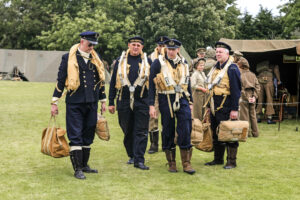 and hotels in Paignton and Torquay where pilots in training were billeted. WW2 saw further demand with the American Navy, who were present on the Dart. Soon water supplies became a challenge, with the Americans stepping in with a bulldozer to deepen the Kingswear reservoir.
Other items were brought to the Laundry, notably a batch of wool duffle coats from one ship which seemed to be forgotten and unclaimed by their wearers. After the war these coats began to find their way into civilian hands, dyed in various colours. And they proved great for the hard winter of 1947 and many years to come.
But come the 1970s. the Laundry lost the Naval contracts and struggled to survive thereafter. It wasn’t many years before it closed and was knocked down , to later be replaced by the little housing estate you can see today.
And the only thing that remains of this little piece of history is one of those Coats of Arms, preserved and restored and mounted in Kingswear Village Hall. Maybe go and look it up.