

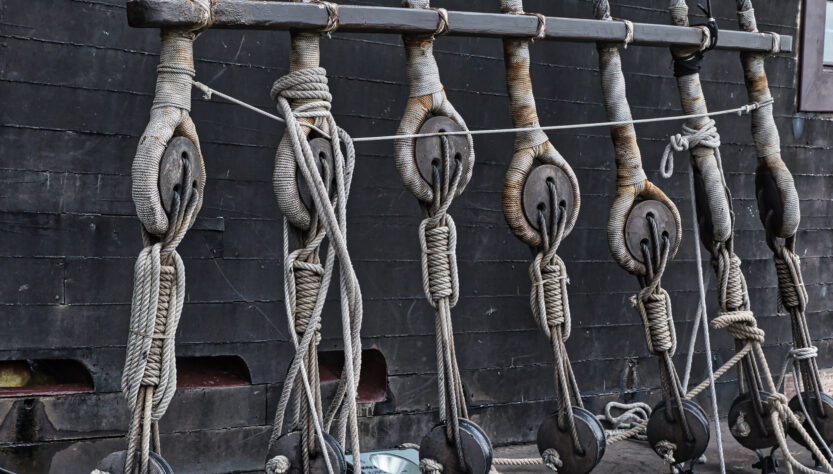
Dartmouth had a great rope making history. Little known to most people, this heritage craft once carried great importance in the Town. It was first mentioned in the town in 1330. And thanks to local Dartmouth and Kingswear historian, Jonathon Turner, some of Dartmouth’s rope making secrets have come to life.
I guess the starting point for my interest, was Jonathon’s description of the locations of some five ropewalks in the town, which go back over 500 years, highlighting where to look to a mere novice.
Rope walks appeared all over Britain where there was a need for long, strong ropes to be made. And with Dartmouth’s maritime industry and sail boat yards, there was a good opening for suppliers of ropes for rigging, for anchoring sailing ships or hoisting their sails.
Thinking about the industrial need for rope lengths, consider this –
 – British Naval rope was typically made to a length of 1000ft , or 300m – showing the need for a 1000ft long rope walk to house its production. There were other Dartmouth rope uses too – like bell ringing ropes for St Saviours Church, or ropes to tie down cannons at the Castle
The rope maker’s craft evolved over decades. And rope walks – long stretches of land or pathways, quite possibly with covered roofs – appeared in the larger rope maker towns. The rope walk could even vary in length and provided a space to twist and lay out rope strands, to produce ropes of sometimes quite extraordinary lengths. And we find there are five in Dartmouth!
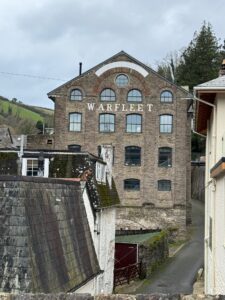
The first Dartmouth rope walk was mentioned on a map of Warfleet in 1749, quite likely part of the Roope family’s shipping and merchant operations.
References also mention one rope walk sited near the bottom of Browns Hill.
The two longest walks are found on Dyers Hill – the woodland area at the end of Above Town, where 2 parallel lengths of land and some remnants of walls and buildings can still be found. These were longer – the larger one being 1300 ft long, versus a shorter 580 ft one, with associated hemp storage building, tar finishing building and storage sites.
Today you can just find the lines of the two walks on Dyers Hill. Heres a video of my pup running along the walk, before I realised its significance! Dyers Hill Rope walk
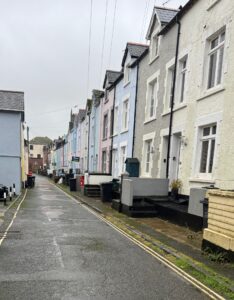
And in 1809, there is written evidence of another rope walk in the area of the reclaimed Mill Pool , in the centre of the town, now more familiarly located as Lake Street.
Coombe valley, however, laid out a rope walk, roughly at the bottom of the BRNC entrance. It was part of the Seale family empire; another sailing family , with visions of making Dartmouth a significant Naval Dockyard. It never really exploded into this great dream , trailing behind nearby Plymouth; it remained cyclical with needs for fishing boats and gradually faded away.
By 1860 , the rope walks were in demise, and steam powered boats, in particular, were pushing out the sailing ships. Gradually these works ended.
Typically the fibre used for Dartmouth’s ropes was from plants like hemp. This was apparently imported from the Baltics in many cases.
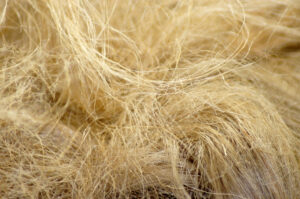
Other plants could be used and even animal hides. But, back to hemp- this fluffy, volatile fibre, had to be carefully handled in the rope walks as the makers worked. The risk of fire was insane! Dust from hemp is highly flammable. And coupled with tar used in the finishing process, many rope walks have caught fire historically. Hence, it seems, the need to site such Rope Walks outside of towns and populations.
Its quite a process in the rope walk; firstly the hemp must be prepared and spun into yarn. The yarn is, in turn, twisted to form strands. The strands are then twisted together to form a rope.
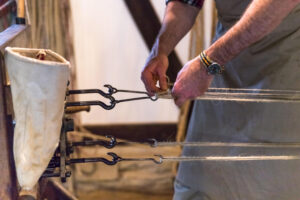 Clever mathematical physics showed that firstly the yarn, then strands and rope had to each be spun in alternate direction, to enable a high quality rope to be made – vital to stop the rope from unravelling and provide a strong finished product.
Ropewalks gave the opportunity for the fibres to be continuously stretched and twisted to great lengths- helped by the traditional workers who would fix between 3 and 6 strands of fibre at one end of the walk. Using a “ donkey” or wooden trolley, strands would be guided along the walk, whilst the twisting continued. And so the fibres would be twisted into shape as the workers moved the trolley along the walk to the other end. Once there was sufficient twist in the strands, they almost automatically formed up into the rope- meaning often workers had to dash to the end of the rope and secure it.
Rope making was a carefully practised skill, with workers held in high regard. Master rope makers had decades of experience in the craft. Experience of tension and level of twist were critical to make a high end rope. It was all quite intensive and time consuming work. As an example, some 200 men could be used to eventually produce a giant rope of perhaps 50 cm twisted diameter.
Inevitably, however, the Industrial Revolution saw the rope making process become mechanised. Machinery introduced from the late 1700s led to automated twisting and winding of ropes that increased efficiency and led to a reduction in manpower needed. Not only this, but longer and stronger ropes could be made for the growing maritime, construction and mining industries

There was always a need for a rope!
Thankfully a few traditional rope walks have been recorded and preserved as historical sites. The last remaining working site is at Chatham Dockyard in Kent. In Dartmouth, however, we can only pick out long and narrow lanes, or may be a walk , which keep the footprint of where these walks would have been centuries ago, in this wonderful town.