

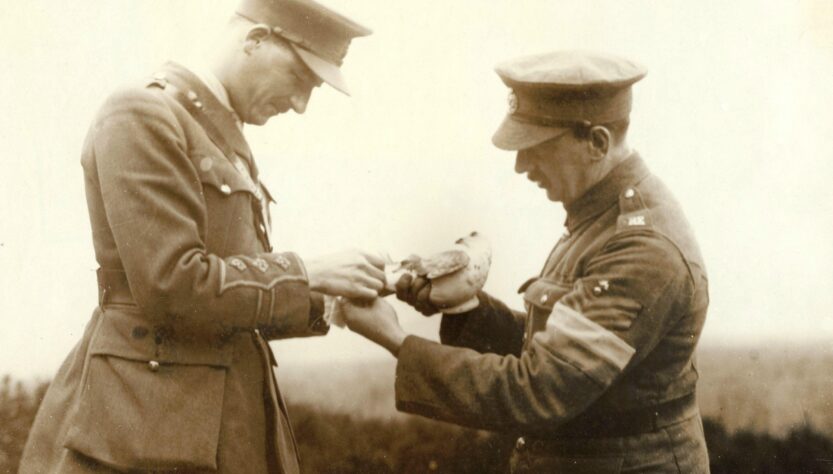
Remembering Cecil “Charlie” Brewer and his beloved Mary.
Stories about quiet heroes in our community really brighten my day; it’s nice to marvel at people – and animals – who have bravely done great things and not craved the limelight.
And so read this – the life of Cecil “Charlie” Brewer and his special, valiant homing pigeon, Mary, who earned the PDSA Dicken Medal in WW2. Mary showed “outstanding endurance on War Service in spite of wounds”. She was honoured in 1945.
In 2018 a landmark blue plaque was placed at 6 West Street, Exeter at the site of Charlie’s pigeon loft
The story starts with Charlie as a pigeon fancier and breeder of Mary.
Charlie was a professional bootmaker and a hobby pigeon keeper. Born in Exeter in 1895, he became a bootmaker’s apprentice, before marrying Edna in 1922 and setting up his own workshop, which was at West Street, together with his pigeon loft. During wartime Charlie was a special constable and played a role looking after war pigeons
He bred Mary and in the 1940s Charlie offered her services to the National Pigeon Service.

The NPS was formed in wartime 1939, initially with 3 members, but expanded with selected members over the country. Each member needed a minimum of 20 birds in their loft and had to be prepared to offer birds for sorties during the war. Charlie and his birds played their part here. Airmen took birds onboard RAF flights. For each mission completed, the fancier was paid four pence -4D. Over 200,000 pigeons flew under this service.
Through the NPS, Pigeons became vital in feeding back locations of downed aircrew – two birds were taken per flight, with their own watertight baskets and message canisters on their legs. Should the plane crash, the birds could be released and carry vital information back home in secret, away from radio signals and radar.
For the NPS pigeon network to be a success, there was a cull of birds of prey along the British coastline, so the pigeons had the best chance of getting home. They could fly across Europe pretty much undetected, flying at 50 mph – almost too fast to shoot down. Some birds could fly a 300-mile distance with their urgent messages.
Latterly the Germans saw the threat of the secret pigeon messaging and also took to using birds of prey to take them down .
And so Mary was put to work – she too was taken behind enemy lines and carried top secret messages back to Charlie’s pigeon loft in West Street, Exeter.
In all, Mary completed 4 successful missions, bringing vital intelligence back from France, and survived attacks upon herself too.
On one occasion she suffered wounds to the neck and breast. Charlie would nurse Mary back to health, diligently tending her injuries, and even stitching her wounds. Mary recovered on each occasion and went back to flying.
She successfully dodged a hawk attack to get home.
On another sortie Mary returned missing a wing tip and with 3 shotgun pellets lodged in her body.
But it was on Mary’s last mission that she returned home with shrapnel injuries to her neck. So severe were the injuries that bootmaker Charlie, sewed a leather collar to help hold her neck up as Mary recovered. It was 1945 and she was officially retired from service thereafter.
The Dicken Medal, awarded by the PDSA, recognises the highest award for animal bravery. In Mary’s case, she won it for gallantry and outstanding endurance.
Marie Dickin introduced the Dickin Medal in 1943, at the height of WW2. She was a devoted campaigner on Animal Welfare and determined to recognise the role of Animals in the armed forces and Civil defence. The Medal is still given today where animals have been fearless and brave in adversity and saved lives.
32 pigeons have received the Dickin Medal – you can find loads more interesting stories of bravery on classicwarbirds.co.uk.
Mary sadly died in 1950. She is buried in the PDSA Cemetery in Ilford. Furthermore, she features officially on the Animals’ War Memorial in Hyde Park, London and in the mosaic on Exeter Railway station.
Charlie lived a long life and died aged 90 in 1985, having spent many years giving talks about Mary and fund raising for charity.