
- How medical training helped the Author’s literary success.
The Poisonous Plants Garden at Torre Abbey in Torquay takes you into the world of Agatha Christie.

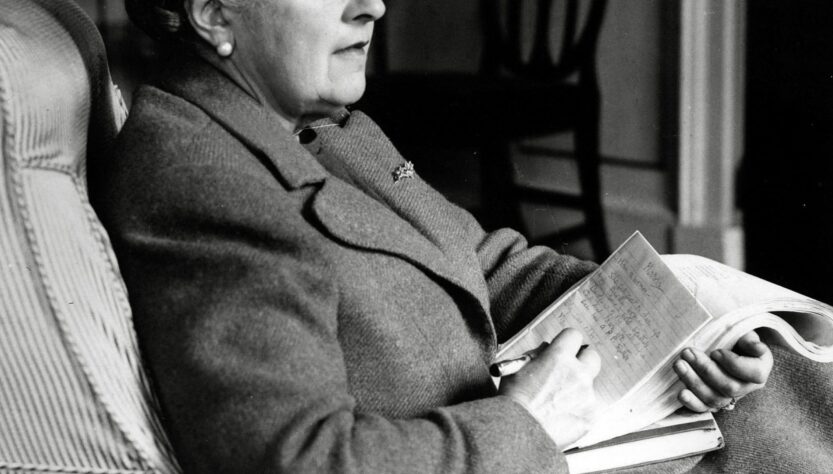
Agatha Christie, the well-known crime writer is a famous resident of South Devon. She was born in Torquay in 1890 and her beloved holiday home, Greenway, sits high above the banks of the River Dart estuary.
It is now cared for by the National Trust and holds some great memories of the famous crime writer.
Agatha was quite a reclusive lady, initially marrying aviator Archie Christie on Christmas Eve 1914, after a whirlwind romance. At the time of their marriage, WW1 had been declared and Archie went off to fight, whilst Agatha worked as a nurse in a Red Cross Hospital in Torquay. Later she worked as a dispenser in the Pharmacy.
Her work in the pharmacy department fostered Agatha’s great interest in medicines – and from this her interest in poisons that her various characters could helpfully use in their crimes.
It was during her time working in the Pharmacy that Agatha wrote her first novel, “The Mysterious Affair at Styles” where the unfortunate victim was poisoned with strychnine. This formula of death by poisoning proved a winning novel plan for success.
When Agatha became divorced from Archie, her crime writing books had to take off to survive. And gradually she penned more and more over the ensuing decades, as her career sauntered along to a happier second marriage with the archaeologist , Max Mallowan and yet more books.
The themes of Agatha’s crimes were so accurately researched that the reader could learn much of the poison of the day.
And here in South Devon, all things Agatha are cherished, including the Poisons Garden at Torre Abbey in Torquay, dedicated to the writer’s life and storylines.
 So, if you are at a loose end, head to Torre Abbey and visit the garden nestled in its grounds .
The head gardener at the Abbey’s poisons garden is Ali Marshall. She has spent many years creating the garden to embrace plants involved in Agatha’s vast numbers of crimes and poisonings . She says the “gardens are designed to entertain and not provide murderous opportunities” – so as far as possible the plant strains are less potent varieties.
There are 41 poisoning events in Agatha’s writings. The main culprits were strychnine, cyanide and arsenic. And at the time of Agatha’s stories, poisons were relatively easy to get hold of, with no signature , and medicines were compounded. Christie researched them meticulously.
Not all plants can be held at the garden, however – there are licencing restrictions for the really bad guys and also the garden must stilllook pleasing to the visitor.
Strychine is a tropical plant, which must only be grown under licence. So you cannot spot that one.
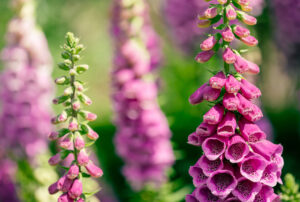
But you may spot seed kernels that produce cyanide, or fox gloves that yield digitalis, the heart toxin featured in “Crooked House”.
Then there are opium poppies that produce morphine, inducing deep sleep and coma in victims, as in the book “Hickory Dickory Dock”.
And dwarf peach and nectarine trees, whose stones contain cyanide.
Aspirin , from Willow trees , features in the novel “Dead Man’s Folly”
As with medicines, and in deed poisons, its often a question of dose for effect. So as you wander around what appear to be fairly innocuous plants like foxgloves of rhubarb , you seem them in a different light – the world of Agatha Christie .