

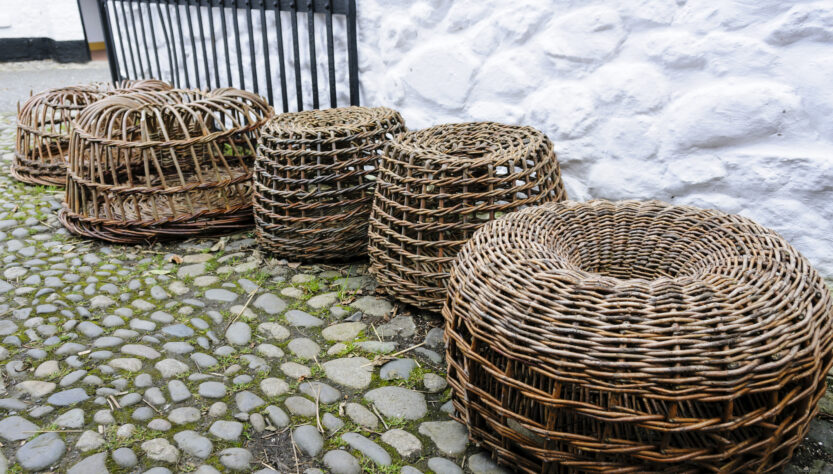
How preservation of old technology can solve a modern ocean plastic problem.
Lobster pot making is on the UK Heritage Craft red list – meaning it is critically endangered to die out. This skill is only really retained along the coastlines of Devon, Cornwall, South Wales, Southern Ireland and the Breton region of France. Only around 11 individuals continue this craft in the region.
 The alternative name for a lobster pot is a Withy pot. And it was more than 400 years ago that Withy pots were first recorded for trapping fish.
Prior to that there were even more primitive fish trapping systems; fishermen would fix traps to the beach at low tide and wait for their catch. As time moved on, fishermen sought to catch fish and shellfish in deeper waters, meaning pots or traps had to be lightweight and withstand being taken out to sea, tossed overboard and hauled in from the deep.
Hence the design of the withy pot.
Now a Plastic Problem
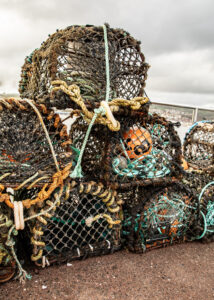
Come the 1960s, however, traditional withy pots started to die out , replaced by stronger pots, capable of being winched out on a more industrial scale. Hence the modern plastic and composite pots that we see today. Their down side is plastic waste entering our seas, and difficulty recycling these old or broken pots.
And if, by chance, the pots are lost at sea, their indestructibility means they keep trapping lobsters on the ocean floor until full of shellfish . Of course the pots would take a millennium to rot down.
Divers in The 1000 Tyres Project, diving in Plymouth Sound , report finding plastic pots abandoned on ocean floors, with giant crab or lobster trapped inside, feeding on their dead mates, or simply starving trapped with no food in a viscious circle. In fact its been shown that a lobster pot on the seabed could trap and kill over 100 crabs or lobsters over 15 years.
Saving Traditional Pots
Withy pots made from willow have a one year life cycle before they start to breakdown – a full-circle, more environmentally, friendly scenario for lost pots; the lobsters could escape as willow pots break down if they are lost at sea.
From the 1960s it became hard to make a living making pots, unless they were linked to a true fishing business with a need for the pots. And of course, inevitably, those still making the pots were of the older generations – with less strength, older, arthritic hands. Few people in a modern Britain are keen to remember these skills for the future.
But our story is the preservation of traditional withy pots, fashioned from willow and how David French and Brixham based Sarah Ready, and Sue Morgan in Hope Cove continue to promote this heritage craft.

Dave is a Plymouth based, fifth generation lobster pot maker, who took on Sarah as a rare apprentice . Often seen at local seafood festivals, visitors will see them in action making the traditional pots.
There are some fishermen who still fish with traditional pots. But pots are also now beautiful pieces in coastal houses and venues, and even features in period dramas like Poldark.
To make a good pot you need a good source of willow – and near to us it is likely from Somerset , where hybrids like Salix Vinimalis , Alba and Triandra are commercially grown in willow beds. Centuries ago, every fishing village had a “ withy patch” that grew fresh willow for pot making.
Soft, fresh willow is bent and twisted by hand into an inkwell shape pot. Sometimes hazel is used as the base. Here in South Devon there are certain features of the pot that are characteristic of the region . These pots tend to have a flatter top and more curvy walls down to the base. There are four turns of spiral binding around the pot in the Devon version too. Each maker would have their own unique style and twists and these often related to how they fished on their particular coast.
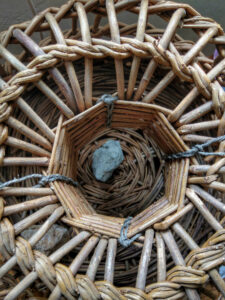
A central funnel is the entrance path for lobsters , who lumber in following bait attached to skewers piercing the funnel. Once down the funnel they are trapped in the base of the pot.
Lobster fishermen knew that traditional withy pots only had a lifespan of around 1 year, and needed constant maintenance and repair. Winters when boats couldn’t go out to sea would be spent weaving new pots for the next season. The willow would be harvested in December when leaves were lost, with a fisherman making around 40 pots for the next season.
Follow these guys keeping the lobster pot with us in 2024 . Thanks to support from local events like Salcombe Crabfest , Plymouth Seafood Festival and Sidmouth Sea Festival there are wonderful locals showcasing this heritage craft.
And there is a bigger dilemma ahead – whether the traditional willow lobster pot could be revived for a greener future.
Who would have thought – the old ways are maybe the best?!