

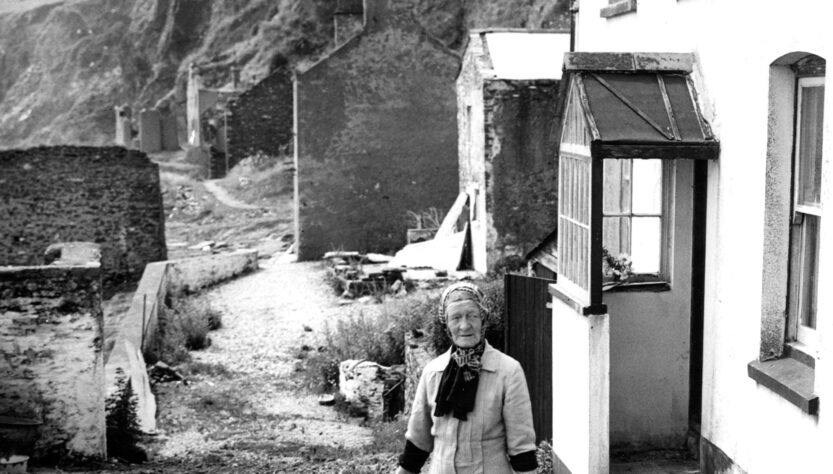
- A devastating illustration of coastal decay that lost a community.
Running along the South Devon Coast, in Start Bay, are the Coastal villages of Beesands and North Hallsands. Beesands is a lovely village with a long pebble beach and a great Fish and Chip restaurant – The Britannia .
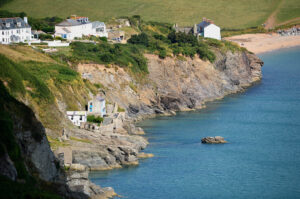
But Hallsands has virtually disappeared. It has a sad story to tell of the events in 1917 when the sea came down peoples’ chimneys and houses fell into the sea.
As Visitors you can head to the viewing platform at North Hallsands, near the only property still occupied – The former Trouts Hotel. And there you can cast your eye to the ruined stone properties that teeter on the rocky edge below.
It really is a story of overstepping the line in the care of our coastlines and well worth a visit. How coastal erosion, by what ever means, can ruin a community.
In the late 19th Century Hallsands was a poor fishing Community with a mere 37 houses, a pub called the London Inn and a population of 137. The fishermen of the village supplemented their catches of crab and mackerel with other trades like blacksmithy and carpentry to make ends meet.
Hallsands meantime was a village living on an exposed rocky ledge with banks of sand and shingle below it running into the sea .
Taking the shingle to build Devonport
It was in 1897 that powers at the Royal Navy decided that Plymouth’s Keyham Dockyards should be extended to accommodate modern warships. What was to become Devonport Dockyard was developed and required vast quantities of sand and gravel for it construction.
Sir John Jackson, a local developer, gained the Contract for the works and an 1100 m stretch of coast line, running under Hallsands, was earmarked and licenced to supply sand , shingle and gravel. The Board of Trade agreed for the materials to be harvested from under the Hallsands shoreline, without the villagers’ knowledge.
 Dredging ramped up quickly and hopper barges moved the shingle to Devonport. Jackson quietly secured a further licence to dredge between high and low water marks from the foreshore also. Removal of 1600 tonnes per day quickly changed the Hallsands coastal landscape, digging out a recess below the high water line.
In 1897 , the local MP, Mr F.B.Midway lodged a complaint on behalf of the villagers that the dredging would threaten the village. But it was thrown out and dredging continued. Jackson paid the villagers some limited “compensation”.
Dredging continued and as a comparison , in 1900, the springtides came within 1 m of houses, rather than the usual 21 – 24 m. Houses were starting to crack and the seawall foundation was eroding. Mr Jackson did order some reinforcement of the seawall and a concrete jetty at this point.
650.000 tonnes of shingle and sand were dredged in 5 years before Jackson’s licence was revoked in 1902.
The village continued to crumble, however, and the London Inn lost a kitchen and bedroom to the seas in 1902. Villager numbers continued to decline
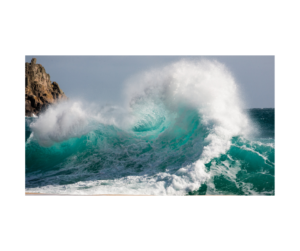 The date 26 January, 1917 was when it all came to the end.
The locals had prepared for exceptional hightides, moving their boats high up the beach away from the Sea ahead of the high springtides.
Waves crashed high above the heights of the houses, houses collapsed, villagers feared for their lives. No houses survived intact.
At dawn on 27 January, many houses had been lost and timber and furniture was floating on the sea. Villagers salvaged what they could and retreated to higher ground . All except the Prettejohn family, whose house remained intact on higher ground . And these guys stayed at home .
Families had lost everything . The Board of Trade argued about compensation with a local inspector claiming dredging for many decades had caused the collapse . Compensation was discussed, but amazingly the secretary to the Treasurer argued and reduced the payment , saying the people of Hallsands were past masters at squeezing out the best offer. And a year down the line they would be over the worst! And rebuilding their lives. How unbelievable !
The Government were so embarrassed by the report’s wording that they declined to publish it until the 50 year rule, just after the second world war . There weren’t enough funds to rebuild what was lost.
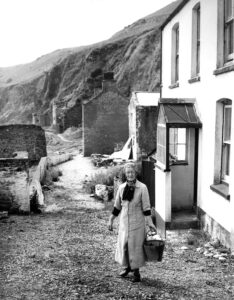
In all this carry on, only one house had been left standing. Elizabeth Prettejohn had refused to leave her home at the evacuation and indeed stayed there solitarily as a spinster with her cat and hens until the end of her days in 1964, at aged 80, saying “ it was the dockyard that took our beach”. She had been born at the London Inn where her parents were landlords. She spent her life fishing in the community and rowing out to sea alongside the men.
A 100 year memorial plaque was erected in January 2017.
Hallsands is now globally known as an example site of coastal erosion due to dredging.
Love this review of Hallsands Julie
There is a really good book in the library in Dartmouth too on the subject