

 Having been defeated at Waterloo in 1815, Napoleon, the failed French Emperor had plans to escape to British soil and spend the rest of his days this side of the channel. This idea was thwarted and the Frenchman’s next journey was one voyage to St Helena and a life in exile until his death aged 51. But not before he had caused quite a stir in Brixham.
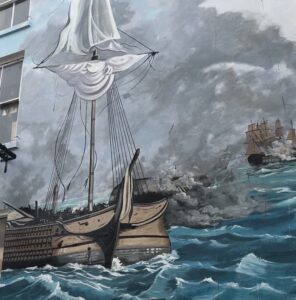
The Brixham Connection. There has been a well known link with Napoleon, his battles and the local town of Brixham . So much so, that there is even a recent mural adorning a large expanse of wall in Brixham’s town centre. It depicts ships on the high seas and the Battle of Trafalgar, plus local hero Nelson. But our interest right now is Napoleon.
Lots of Battles. Napoleon had come to power in 1804 after the French Revolution. He was flying high with victory at the Battle of Trafalger in 1805. For just over a decade the French forces picked fights with much of Europe. In 1812, a disastrous fight with the Russians saw Napoleon abdicate and sneak off to exile on Elba, Italy in 1814.
That didn’t last long – Napoleon escaped back to France for Round 2. But neighbouring countries including Britain , backed up by Austrians, Russians and Prussians, decided to end his reign once and for all. And at the Battle of Waterloo in June 1815, Napoleon was defeated.
Trafalgar was the 1805 victory. Napoleon’s reign was brought to an end at Waterloo in 1815.
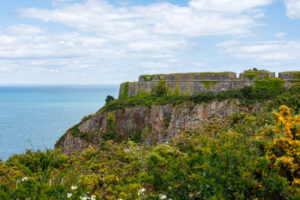
The Fort at Berry Head. For our Brixham story, we must firstly take a look at Berry Head – a prominent finger of land jutting out into the sea from Brixham, at the edge of Torbay . It housed a fort in the late 1700s and played an important part in the defence of Britain against these invading French during the Napoleonic wars of the 1800s. Berry Head afforded a great look out point over Torbay for enemy ships; it was also a security post and launch point for attacks on foreign ships spied from this high land. A Guard house at the entrance controlled movements onto site – still standing today and repurposed as a brilliant Café. Soldiers trained within the fortified grounds. Training which would prove useful against the Napoleonic Wars.
The Napoleonic Wars were fought at sea, with the French seeing the British shores as a useful target for acquisition. Napoleon was the prominent French leader.
A Secret Visitor. Now a rather unusual event happened off Berry Head on 24 July 1815……
The Napoleonic Wars had ended with Waterloo and Napoleon surrendered to the British forces that were chasing his tail.
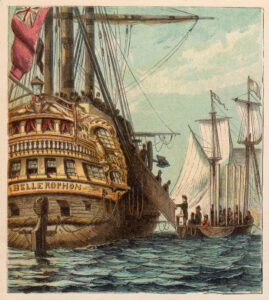
HMS Bellerophon at Brixham. The Frenchman was being held on HMS Bellerophon, a 74 gun battleship, whilst he awaited his fate. Torbay was the first haven reached en route. And as this ship, lead by Captain Maitland ,navigated Torbay, Napoleon thought he would do a bit of negotiation with the British Prince Regent – may be gain free passage to America. He would ask the British Government for protection. If America failed, he would probably claim asylum in Britain and live a gentlemanly life on British shores, away from all the War and battle nonsense. He was somewhat deluded!
Maitland recorded Napoleon’s conduct aboard ship as he awaited his naïve plans to unfold. Napoleon was complimentary about the Devon coastline. He said that local fishermen had often been in his pocket for intelligence and laundering money to France, let alone assisting prisoners to escape.
As they loitered around Torbay, Maitland needed to keep Napoleon’s presence a secret – thereby preventing attempts to rescue him from the ship by loyal followers. The ship dropped anchor off Brixham, with instruction that no one was to board. Little did Napoleon know, but the British Government had decided to exile Napoleon to the Island of St Helena. That wasn’t on the Frenchman’s radar.
The Locals come out. It didn’t take long before word got out that Napoleon was aboard the Bellerophon, just off Brixham. Soon local boats with scores of people gathered in the bay, near the ship. The locals were just looking for a glimpse of the fallen leader.
It was common practice for local tradesmen to row out to Warships that entered the bay and trade their wares with occupants on board. On that sunny afternoon , local baker, Mr Michelmore, rowed out laden with freshly made goods , hoping for some healthy sales. Michelmore’s three children had time off school, said to be in celebration of the recent Battle of Waterloo victory. Great excitement as they hooked onto the Bellerophon’s hull to start their trade.
Quite out of character, the ship’s crew were hostile – pointing guns and ordering Michelmore to detach from the ship, or he would be sunk.
They Saw Him. It was then that Napoleon’s cover was blown . The fallen Emporer was spotted that first afternoon, dressed in his favourite uniform. Flattered by the attention, Napoleon bowed to the gathering flotilla. Sometimes he would appear at his cabin window.

It is said in some quarters that a crew member threw a bottle into the seas. And the message inside read “We have got Bonaparte on board”. That’s a great story if proven true.
Brixham was soon buzzing with news of the famous prisoner off shore. It was a good tourist attraction whilst it lasted. Quite an event – locals turned up in best dress outfits and even brought gifts to the stranded Frenchman.
To Plymouth The Ship’s crew became concerned about security and set sail for Plymouth on a bit of a round tour, away from the small boats and nearer the secure Naval base. This just served to publicise the important passenger to Plymothians also – with reports saying up to 10,000 spectators turned up. Finally, the Bellerophon returned to the Brixham area to transfer their captive to HMS Northumberland, anchored just off Start Point on August 7th ; the ship which would take him to exile at his final St Helena destination, 5000 miles away.

Into Exile. And St Helena was where the Emperor lived out his days, He died at just 51, in 1821. A man in very poor health, one theory said he probably succumbed to arsenic poisoning – either from the wallpaper decoration he had been exposed to, or being fed it by one of his fellow French men who thought his time had come. Others thought he suffered from stomach cancer.
Either way, Napoleon’s quirky trip to the Brixham shoreline has gone down in local town history.