


Summer is upon us and Torbay is alive with visitors enjoying the welcome sunshine.
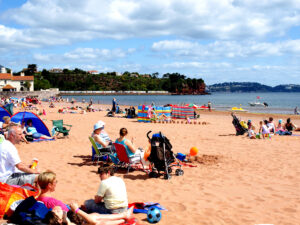
But out in the bay, under the water , there is a bit more than the kayaking and boat trips above.
Torbay waters have become home to Seahorses. And here’s how this heartwarming bit of seaside conservation has evolved..
The Seahorse story wouldn’t be as it is today without one brilliant conservation enthusiast, who has devoted all his time for over 50 years to the understanding and preservation of this little creature. Enter Mr Neil Garrick – Maidment. He’s even been recognised as winner of the 2023 David Bellamy Award for naturalists in the field.
Neil has been instrumental in taking best steps to preserve Seahorses worldwide and set up the Seahorse Trust in 2000 . As a young lad he was asked to raise baby seahorses hatched at Paignton Aquarium . And so his passion grew.
Recognising his work are many celebrity ambassadors like Ellie Harrison and Chris Packham, and healthy seascapes are now widely promoted for seahorse survival.
There are two species of Seahorse in the UK and both are found in Torbay; the spiny seahorse and the short snouted seahorse.

But the story starts with sea grass…
Seahorses are a tremendous indicator of the health of the sea floor . The Seahorse Trust project knew the importance of thriving sea grass meadows as their starting point . And then, amongst that grass, a variety of species like spider crabs, congor eels and the tiny seahorses who can hide so brilliantly.
Neil has returned to the study of Seahorses in Torbay just recently. There are 4 or 5 sites along the south coast within the study. Sea grass study was the remit. Indeed the first dive gave an unexpectedly fortuitous result, on the back of the primary intent of searching for seagrass beds – the seahorses.
On their first dive to the seagrass site in Torbay in July 2024, Neil’s team found that – where there was meant to be a small amounts of seagrass – the area actually had quite extensive meadows, thriving quite happily. There were large areas across the bay housing many sea species. And amidst these meadows they saw 3 short snouted seahorses . The divers in Neil’s team even got to see one hunting – quickly snapping at passing shrimp.

The discovery of seahorses meant the team embraced full respect and compliance of the legal protection that seahorses have. Since 2008, it has been the law to have a licence issued by the Marine Management Organisation if you are actively seeking protected seahorses. Neil’s work here provides such a lot of conservation information and the site remains secret and protected.
It was 35 years previously that Neil had dived the same seagrass site . And it was a revelation to return this time to a thriving bed and the multi species hiding within for study. The Torbay site allows a comparison to the Seahorse work on Studland, in Dorset, where seahorses have been so protected that they are thriving.
Later dives to the same Torbay site have also found the second species – the Spiny seahorse. Interestingly too, the group reported finding a pregnant male Greater Pipefish. This is the true ancestor of the seahorse. Unlike the seahorses who maintain young via a placenta, the Pipefish carries a mass of fertilised eggs in its pouch. It lacks the seahorse neck and bent down head and the curly tail.
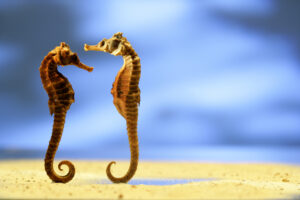
Seahorses are a clever mix of features; they are actually fish with gills and poor swimmers at that. They are chameleon like and can change their colour to hide in the grasses. And as Neil has said, “they have the tail of a monkey, the pouch of a kangaroo, a head like a horse and a snout like a straw to suck through”. These little creatures do mate for life . And it’s the male who carries the pregnancy and delivers the young.
So, yes, seahorses are a marvel in many ways!
They use their tails for hooking and holding on, or trapping competitors. They steer their movements with their dorsal fin and tiny fins by their ears. There is elaborate courtship and daily greeting rituals between mating pairs. The female is the egg producer and she introduces her eggs into the male horse’s pouch , which immediate seals. Fertilised eggs attach to the lining of the pouch like a placenta and around 20 days later the male seahorse propels mature tiny sea horses into the world.
A worldwide register was set up by Neil to record live seahorse sitings. Remember at the other end of the scale, 150 million seahorses each year are hunted for use in Chinese medicine and as holiday trinkets – over a million each year go to supply the so called curio trade.

Torbay has over 80 hectares of seagrass beds. This is around 30% of the seagrass along the Devon coastline. It particularly flourishes around the corners of the bay – near Torre Abbey Sands, and at the opposite end around Fishcombe and Elberry Cove. Maps are published so the areas can be highlighted and avoided. The seagrass helps the coastal ecology and water quality – filtering pollutants and making oxygen and the root networks help protect against coastal erosion . Let alone providing the ideal home for many species including our seahorses.
Conserving the seagrass area and thus the Seahorse habitat goes hand in hand . And one of the biggest disruptors are boats that trawl the sites or cast anchor and destroy the quiet environment below. This is very evident in Dorset, but hopefully remains less so in Torbay. Hence guidelines are in place such as anchoring away from the sites to avoid root pull, speed restrictions, not placing nets in these areas and avoiding passing over with propellered craft , particularly at low tide.
In Torbay, these so called blue meadows are marked by Buoys. And donors like Scottish Power Foundation have helped fund the deployment of hessian pillows carrying seagrass plantlets into other Seagrass restoration sites in the bay too.
The Torbay seahorses are a story of thriving nature in our world where we hear so much misery about climate changes. And I have no doubt that some support for The Seahorse Trust would be most welcome, if you care to look them up.