

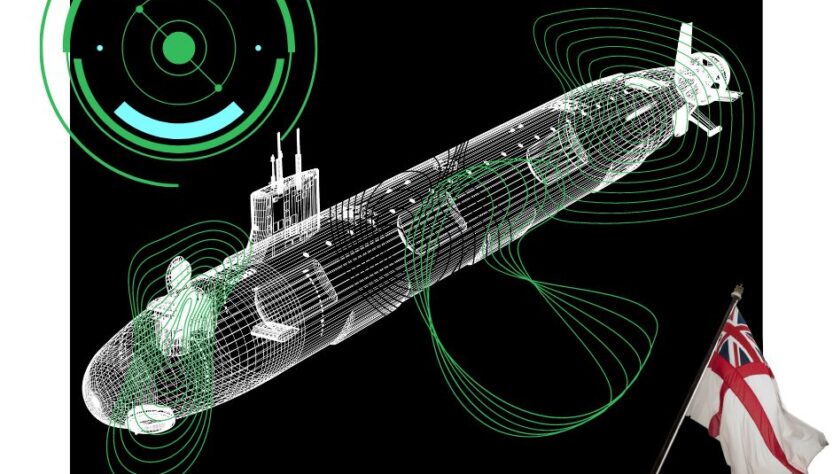
- Technology confirms the long held memories of the locals in Dartmouth!
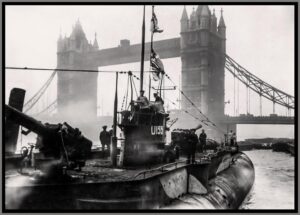
This week has seen much excitement about finding a submarine buried under the lawns of Dartmouth’s Coronation Park – there were radio interviews with the experts who have applied radar technology to seek out the hidden vessel.
The legend of a hidden submarine has been known by Dartmouth locals since the 1930s.
And now there is radar confirmation, added to documents and photos held at Dartmouth Museum, that the long held story is true.
Lets start in 2012 – when an interview with David Lingard, at the Dartmouth Museum, discussed the story of a buried submarine in the park. The museum confirmed the idea of a submarine – probably a british submarine – adding they had photos to back it up. And indeed, an old newspaper cutting indicated there may also be a motor torpedo boat buried there. So two vessels were hidden under the park. A submarine buried on land is most unusual.
In 2012 , South West water were tunnelling in the park, under the recently refurbished tennis courts to lay sewage pipes for nearby Coombe Road. So the question arose whether the workmen would unearth the buried submarine or disturb it. Hence the story surfaced.
Coronation Park was part of the Dart Estuary until the 1930s , when it was reclaimed to land. It was known as Coombe Mud – the esturary being filled in between 1928 and 1929 by miners from Wales who were employed to labour.
So where is the U-boat beneath the park?
Legend suggested it wasn’t anywhere near the route of the sewage pipes, (the site of the tennis courts in the northern most area of the park).
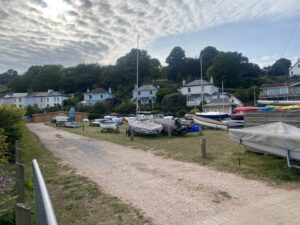 Photographic records, instead, indicate the submarine sits more on the left side of the park as you look towards the river, near the Higher Ferry slipway, where all the dinghy boats and canoes are stored.
2022 arrives and Tom Kemp, a Royal Navy Officer at BRNC is going through all documents he can find relating to the hidden submarine. Two potential vessels come to light – HMS A8 and HMS E52. He thinks he has identified the submarine as HMS E52 – noting it was unceremonially buried under rubble and other landfill after WW1.
Lieutenant Kemp reports that HMS E52 sank a German U-boat , UC – 63, which torpedoed her at close range, killing all crew except one Lieutenant Commander Phillips who received the DSO Medal for ‘Services in Action” with enemy submarines.
Coombe mud in Dartmouth became a breakers yard for these unwanted ships and submarines. HMS A8 was a smaller submarine and was largely broken up in 1923. But the other submarine, E52, was larger and proved much harder to dismantle so was left more intact on site.
In the late 1920s Coombe mud was acquired by the local authority , who proceeded to fill in the site and bury the metal work beneath, to create Coronation Park – so called in honour of King George VI in 1937
Now, in 2022/23 bring in Geo – engineering experts to help investigate the missing submarines. Two researchers from the University of Winchester have come on board, to follow up Tom Kemp’s enquiries. There’s David Ashby from the soil laboratory and Simon Roffey – a reader in archeology who is also an ex- submariner.
 The expertise they brought to the score was GPR – ground penetrating radar – to scan Coronation Park and help locate HMS E52. It sent sound impulses down through concrete and tarmac to the objects below. The equipment produced data in 10 cm slices down to a depth of 4 m. And the team found 2 large anomalies of presumed metal construction.
This equipment helped to confirm Lt Kemp’s suspicions on the submarine location under the kayak and canoe stacks on the park. A blurry outline of the expected submarine was seen on the scans , together with a second, longer and narrower object – thought to be the torpedo boat.
The conclusion?
The researchers decided E52 was lying in the north east corner of the park, whilst at 90 degrees was a second object, most likely the German torpedo boat destroyer , S24. Both had apparently been bought for scrap after WW1 and bare little resemblance to their design some 80 years ago.
Importantly – the scan results corresponded with a 1920s aerial photo held at Dartmouth Museum showing two craft sitting in the mudflats.
The next stage in the story lies ahead – the researchers are seeking permission from the authorities to dig small bore holes in the park , to hopefully confirm the metal or equipment below ground is unique to E52.