

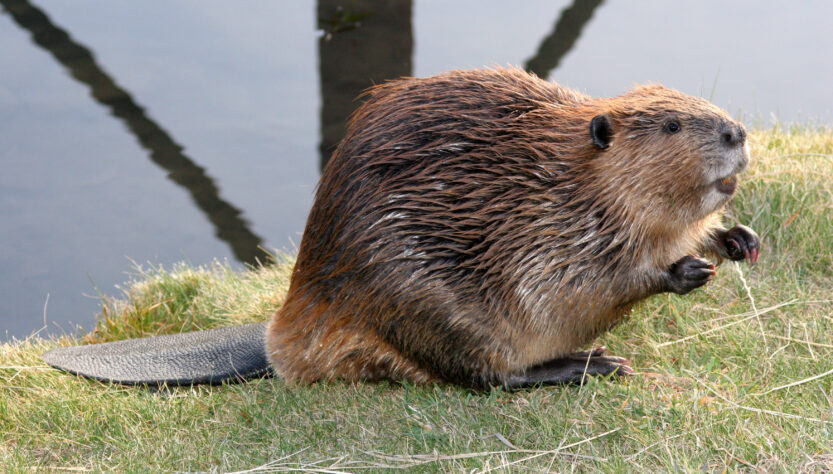
Calling in Nature’s Water Engineers.
Well its quite a success story – beavers are thriving in Devon, with great conservation management aided by the Devon Wildlife Trust.
Beavers can be seen as destructive creatures and a threat to farmland. But on the River Otter, beavers have proved that this is far from reality. The beaver trial that ensued proved that the benefits to people and land far exceeded any negative worries. Here in Devon, beavers live
 happily in the community, manage some of our wild spaces, and benefit the lives of locals and farmers who live amongst them with great excitement and enthusiasm.
Beavers were hunted to extinction over 400 years ago – being favoured for meat , their fur and their scent.
My story starts in 2013, when Tom Buckley, a wildlife enthusiast and photographer, in Ottery St Mary , filmed beaver kits on the River Otter. He had noted characteristically fallen trees on his local river. And by chance set up his cameras on the off chance a beaver was at work. Who could have predicted where this story would end up?
From his observations two things were confirmed – not only that beavers were living on the river, but they were breeding too .
Beavers aren’t allowed to be randomly released in Britain . Reintroduction of is under Government control. At the River Otter, the Government initially proposed removal of the beavers, citing disease risk concerns. But a campaign by the local residents followed to save them. The Devon Wildlife Trust got involved with their knowledge on how the animals could help create thriving wetland habitats. And so the journey started.
The DWT secured a 5 year trial watching the beavers in Devon, resulting in Government approval for them to stay, breed and live freely. Animals were trapped, health tested, tagged and released. On 6 August 2020 , Rebecca Pow, the Environment Minister signed the first legally backed reintroduction of this extinct native species into the wild.
They got the green light!
A further two family groups were then released in 2015, rising to 15 groups by 2020. More beavers may join in future to increase genetic diversity.
The place to see beavers is the village of Otterton. Here the River Otter is well placed with footpaths along the lower reaches of the riverbanks. If you are unsuccessful there, then walking upstream towards the footbridge over the river near Colaton Raleigh is another good place.
.
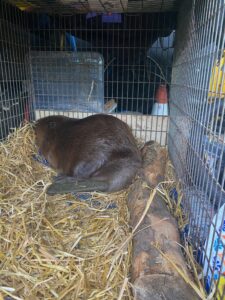
There are a few things to check out about the beaver – they are really huge vegetarian rodents, growing up to 30 kg weight.
They have a characteristic flat tail that is multipurpose – good as a rudder, or a prop, and useful to slap in the water when there is danger. They keep coats groomed and waterproof thanks to an adapted split claw on their hind foot . This helps maintain a waterproof exterior!
The creatures are active at night. On a summer’s evening beavers may be seen playing , feeding or grooming on foot paths, ahead of night time patrols and sleeping at 7 am .
But why do they build dams?
Beavers don’t live in their wonderful dams; the dams are built to create a pond for protection.
A deep pond is built, and the beaver will then build its burrow home – a small island lodge with domed roof in the water, typically dug into the riverbank or dam, It is mounded up high. And inside the lodge there is a dry living area and an area to store food for winter. These creatures don’t hibernate.
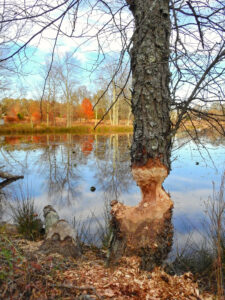
Beavers love to eat willow trees in particular. Ingeniously they can fell a tree, and create a channel to float the wood back to their lodge for later to eat and dam build
They are free to build dams where they choose. But dam building is no good on fast flowing rivers where the water is too powerful. Instead, beavers choose the smaller tributaries and side rivers. Dams can be quite dynamic and affected by water flow. There are no main dams on the River Otter – the survey identified 28 dams in 6 beaver territories . The River Otter stretches for 594 km and of all this length, only 1.9 km is impacted by dams.
Beaver value is in the ability of their dams to stall peak water flow and reduce flood risk. Dams can save water and create wetlands, avoid droughts and save top soil being washed away. Wildlife populations like salmon and trout thrive, even jumping the dams and spawning more. Ecosystems settle and factors of concern in climate change are pushed back.
The beaver project also learnt the need to manage any potential negative consequences such as beavers causing localised flooding of fields and gardens, blocking culverts, felling prized fruit trees. The NFU raised issues like undermining river banks, impeding field drainage, and waterlogged fields rotting crops.
In one area 0.4 hectares of organic potatoes were spoiled as the land was too water logged. And Beavers have been seen feeding on maize, even making their dam near to where the crop was planted at the field edge.
The overall picture is one managed success story.
Our great conclusion to this story is the bigger ecological picture that is emerging – how beavers can help protect against future effects of climate change.
Take a visit to Otterton when you can.