

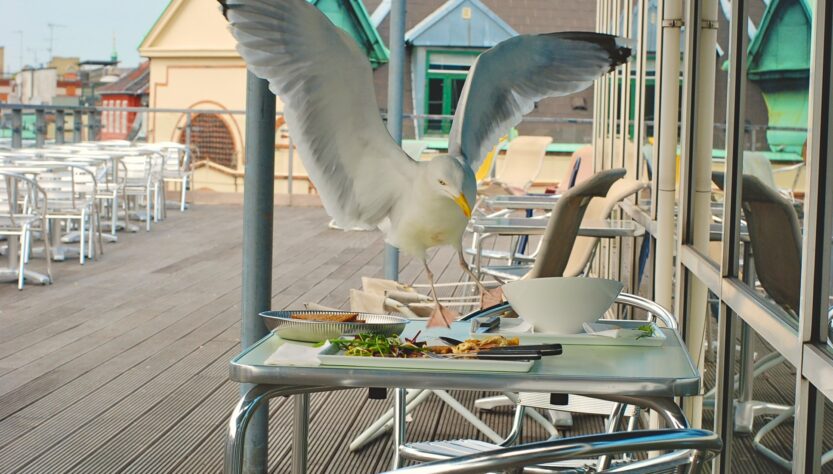
- Hey – that gull stealing your chips is pretty smart.
Seagull Attacks
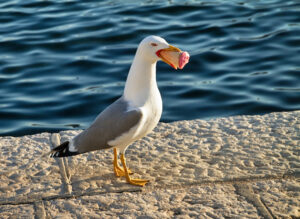
All too often we hear the local seagulls have been “at it again” – swooping down with stealth-like tactics upon some innocent tourist in our part of Devon.
Sat there enjoying the views and hospitality, the first thing the ill-fated visitor knows of the attack is the sight of their longed for pasty or ice cream flying off in the grip of a local seagull. The seagull is the kind of bird who thrives on tactics, location and approach.
Seagulls are your seaside rebels – sometimes entertaining and funny, but you often wish they would go and sit quietly further along the harbour.
Smart Yet they are actually quite smart in the bird world – quickly learning from us humans that they live amongst. They learn our patterns of behaviour, how fast we move and, importantly, what we like to eat. Its worth noting they tend to favour approaching from over your shoulder from behind. So one tip to protect that ice cream would be to sit against a wall or fence as you eat your snack, on this basis.
Spring time breeding Right now the birds are frantically mating and nest building. I can see them sitting amidst the chimney pots and roofs all over Dartmouth. There’s lots of frantic swirling around at dawn and dusk, and squawking as the gulls dive bomb their targets . Of course these birds are ever more wise to living with
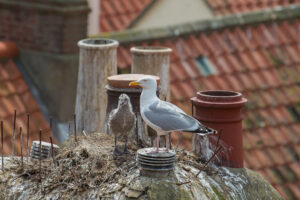
the benefits that people can offer.
The gulls like to build nests high up with good vantage points of any threats. And they are often skilful to build nests on sloping roofs – often wedging their nests up against a roof seam or chimney breast for good structural support.
Sloping roofs You might think it’s a weird choice to pitch on a sloping roof, but this seems to mimic true wild life – when nests are pitched on coastal rock faces. When the young learn to fly, they can slide down the pitch on their bottoms and have a good chance of staying protected where they stop, still being get fed by their parents. Or maybe they scale back up the roof to the nest. Falling out of a high nest would be most likely catastrophic.
We’ve mentioned how smart gulls are – and they have learnt to copy.
Copy Firstly gulls copy parents and elders, who raise them from hatching. That continues to learning from people too.
A couple of years ago, researchers at the University of Sussex published evidence that this cheeky way of copying each other is the reason these birds can learn to mimic the food choice of families and tourists. So if you want chips , or an ice cream, then so does the seagull.
Gulls in Brighton were studied watching peoples’ crisp eating habits. If the gulls saw people eating from a blue packet of crisps, rather than green packet, then the gulls would do the same and check out a blue crisp packet first for food.
Seeing someone eating triggers the gulls to check out what’s nearby – and even learn to choose that same food themselves later on.
Fish in preference Given the choice, however, the seagull would prefer a fishy meal. – thanks to work from Exeter University – we know its fish first ahead of snacks and fast foods. But when the birds are hanging around our seaside towns, they get lazy, cant be bothered to fly off and fish and so copy people for the easy fast food choice nearby.
Steps to control Given the increasing problem of seagulls invading our lives, society takes steps to control them.
And below is a ramble of tackling the opposition.
Seagull proof it As residents we seagull proof our waste – recycling and separating food waste from other types – holding it in sealed seagull proof sacks until collection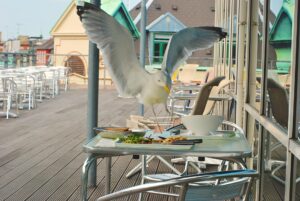 day. Visitors may not appreciate the value of the black hessian sacks hanging from pegs outside houses. But they sure help with litter control!
Of course its wise to avoid feeding the seagulls, no matter how appealing – as they soon bring their mates round to share your hospitality.
Don’t land here! Simply warding the birds off when they dive bomb nearby is a tried and tested tactic. And I’ve known neighbours discourage them from landing near by with a water pistol too. Hanging shiny things near your home and windows can deter the birds – with light reflection from old plastics or CD’s acting to confuse navigation routes.
There are barriers and roof spikes and netting too, that discourage birds from choosing to nest on the pitch of your roof. But you must place these “out of season”. Similarly , it is illegal to move a nest until the season has passed and the birds have left. Gulls come back to the same site every year . Some live for 30 years and they mate for life. So if we are going to react to an unwelcome lodger, we have to plan for a proper farewell.
Bring in the hawks
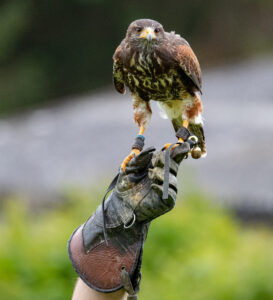
In large spaces, falconry has found a place and proves to be really effective. Don’t be concerned that the falcon employed will attack our local gulls. More – it’s a clever use of persuasion that works wonders!
Torquay United Football Club are one society where hawks have proved a great match asset. The team found there was a pattern of the gulls descending after half- time onto the pitch and surrounds. It seems to coincide with all the snacks and food generated at half time. Thanks to expert local falconers they found that flying a trained hawk around the grounds at games, or even just her presence at the grounds, deterred gulls from coming into land. And that has proved enough – the herring gull “ jungle drums” warn each other there is no point in landing at football matches with this predator in situ.
That’s a fair warning as falcons and hawks are the only real predator to these confident seagulls.

North Devon Council had adopted a similar hawking tactic in Ilfracombe. The gulls were becoming increasingly aggressive towards visitors, prompting a call for action along the seafront.
And at Devon waste transfer stations, “Avro” the Harris Hawk entered the arena. And she proved a great way to deter gulls from hanging around waste stations and rubbish tips. Avro has proved a safe way to cut down on seagull mess and noise and move the birds onto other, more natural, areas. The hawk simply needs to appear on her handler’s glove to gain the gulls’ attention.
Lyme Regis Coucil has been known to go one further- hiring two bald eagles to protect the town from seagull terrorists. This also proved really effective, but too costly to maintain year after year.
Even Brittany Ferries at Plymouth started flying hawks to protect visitors using the ferries at the coast.
Protected
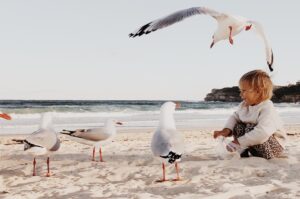 But remember – Ultimately the gulls are protected under the Wildlife and Countryside Act of 1981 – and if they have nested to breed , we should leave well alone until the young have fledged. It is illegal to kill these birds, their chicks or move or injure them. So try to live happily with them , at least until autumn..
Or book a hawk patrol.