

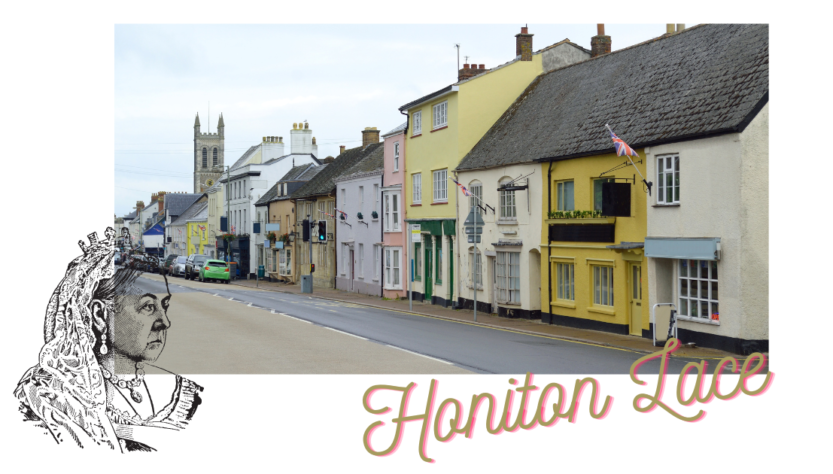
How Royal interest helped Honiton’s bobbin lace industry
On 10th February, 1840 , the young Queen Victoria married her beloved Prince Albert.
Her silk satin dress and accompanying veil were lavishly trimmed with lashings of Honiton lace. And this some what “demand” by the Queen for such adornment is thought to have helped a fading hand -lace industry, that was being overtaken by mechanisation. It is said that the lace commission cost over £1000.

The Queen had put Honiton on the map. Well not only Honiton, but Beer, a neighbouring coastal village , where workers produced this piece of intricate lacework under the direction of Miss Jane Bidney. Miss Bidney was a native of Beer, who had moved to the City. And she was commanded by the Queen to leave her London studio, just round the corner from Buckingham Palace, for the purpose of supervising the lacemakers on the Queen’s project.
It had taken over 200 people around 6 months of the previous year to make the lengths of lace for the royal dress and veil . A skilled lacemaker would take 8 – 10 hours to make one square inch of lacework. Many people were kept in welcome employment by the Queen’s request.
The lace pattern for the Queen was delicate and detailed and so exclusive that the patterns were even destroyed on the dress completion.
Honiton has a long history of lace making – from as far back as the 16th Century, when wives and daughters of farm labourers took up the art to supplement their incomes. It was built upon European influences. The Devon weavers already produced finely spun yarns. And new lace making brought the change to finer materials.
There were also good business links with London; the Honiton area allowed access to gentry and workers. Indeed the whole area of East Devon made lace – over 5000 people were engaged in the trade in the 1600s – including in towns like Beer and Sidmouth. The name “Honiton lace “ fell into place since Honiton was the largest town involved with production.
 Honiton lace is made by a bobbin technique; a multitude of fine threads wound on slim wooden or bone bobbins are woven in intricate patterns , pinned to padded cushions. Often there would be delicate flowers and leaves within the design . The overall large project would be set out by a design artist, whilst smaller items like motifs, edging and cuffs would be produced by the poorer outworkers.
The 19th Century saw Britain’s industrial revolution – mechanisation of many industries. And Lace making was also touched. Here came machine-made lace – much more cost effective on large scales. Nottingham was an important hub for machine lace. But within Devon there was change too.
Enter John Heathcote, who brought lace making machines up the road to Tiverton , in mid Devon. In the decades that followed, Honiton lace fell into demise and the industry died. By 1940 , true Honiton lace production was no longer.

Honiton lace is now rated as a hobby. There is a Museum in the town – the Allhallows Museum, which traces the history of this lovely lace. Antique pieces of this lace are still available.
Queen Victoria continued to patronise Honiton lace – commissioning pieces for Royal Christenings and her daughters’ wedding gowns.. And latterly other Royals kept up the tradition, including Princess Diana, who had a small amount of Honiton lace on her wedding dress in 1981.
When Queen Victoria died in 1901, her wishes were that she was placed in her coffin wearing a white dress and her lace wedding veil. As a result, there are few memories and only occasional photos of this wonderful piece of work , since more than 100 years have passed since the veil was last seen in public.