

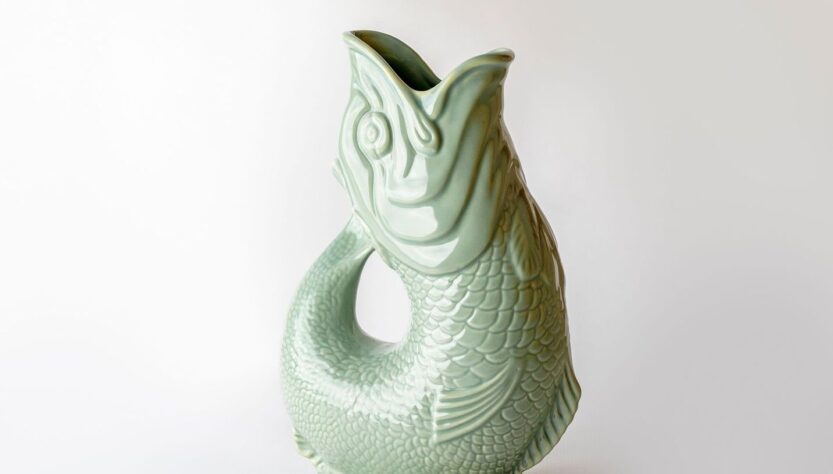
It was produced in the Grade II listed, Warfleet Pottery Mill building that stands just outside the town hub.
The gluggle jug, – or gurgle jug as it is also known – has had something of a revival . Thanks to the TV programe “The Great Pottery Throwdown”, a whole nation is now aware of these iconic jugs and their gluggle sound they make as the water is poured out. High Street retailers even sell a colourful range of the jugs in 2024.
But who knew they have an interesting history that starts in Dartmouth?
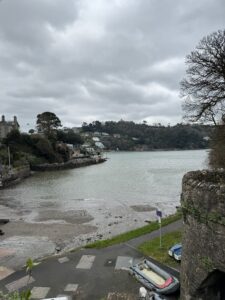
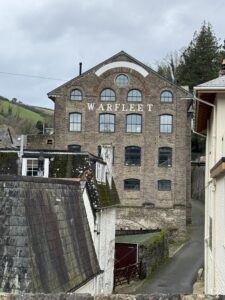 If you are keen to explore the Dartmouth area and take the road to the Castle, you come upon Warfleet Creek.
And standing to the right, facing the water is a four storey industrial style old mill -Warfleet Mill, still displaying its name in big white letters on the red brickwork.
This is the centre of the story.
The Pottery Mill at Warfleet began as an early 19th water powered paper mill. Its production changed from paper to a brewery , which closed in 1929.
It was also a flour mill , before it was taken over by the British Army in WWII and used as the headquarters for commandoes during their training at nearby Gallants Bower.
Life of the mill as a Pottery started just after the war in 1948.
Once set up , Dartmouth Pottery existed until 2002 and was one site of numerous potteries collectively known as ‘Torquay’.
So the Pottery started up just after the war , under the direction of Howard Koppenhagen. It was a strange time to start as wartime restrictions were still in place – restrictions that dictated the pottery dyes available, and therefore the colour of the pottery made. We were still in the realms of dull brown and amber pottery, or may be white. Or lastly pottery from blue dyed clay.
As production got underway, many contracts were for so called mottoware – pottery embellished with text or writing. Or there was work making up orders from other potteries.
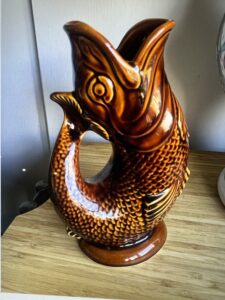 Bizarrely the Dartmouth Pottery seemed to skirt the colour restrictions and were able to colour decorate work for the other potteries. This flexibility was a key to the gluggle jug story. There is history that the jugs were originally made in around 1870 by both Thomas Forester and co. and Morley and co. Later , in the 1930s, Grimswade pottery made these jugs.
Grimswade had faced restriction in the 1930s due to the war effort. And restrictions were still in place in the late 1940s, such that the company was unable to allocate any materials to meet fresh orders for gluggle jugs.
Enter the newly established Dartmouth Pottery

They had spare capacity and few wartime restrictions. So production began, slip casting – that’s pouring liquid clay into moulds – to create the jugs for Grimswade. In return Dartmouth Pottery had the right to keep and use the gluggle jug moulds.
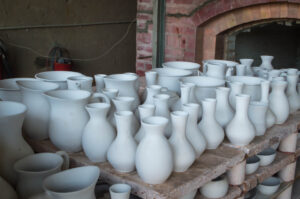
Production ramped up and jugs were produced with some variations. Dartmouth Pottery even produced its own version of the jug – known as the Cod Fish jug. When the pottery building was changed to domestic renovation for apartments in the 2000s , the master blocks for these “new gurgle jugs” were found in the pottery cellars!
Come 1958 , Dartmouth potters were selling the Grimswade designed jugs as their own .
Various novel commissions followed, including a pair of jugs for Queen Elizabeth II and Prince Philip on occasion of their visit to BNRC in 1958 complete with the Royal Seal and date.
There were other jugs in brighter colours , or metallic colours or multicoloured patterns.
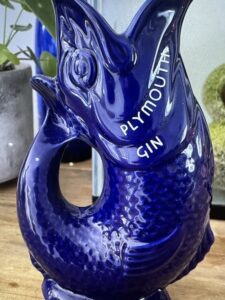 Plymouth Gin commissioned a larger size jug in blue dyed clay with moulded letters, some of which were meant for promotion in the USA. Then followed other themed jugs for whiskey and liquor companies.
There was even a gurgle jug to celebrate the marriage of Charles and Diana in 1981.
In the 1980s, Wade Ceramics bought the gluggle jug rights to the jug production , which had been a successful part of the business and moved up to Wade’s pottery in Stoke on Trent. Sadly Wade Ceramics went into administration in 2002 and the “Gluggle Jug Factory” acquired all the intellectual property rights.
On a good note, however, the Gluggle Jug Factory reemployed Wade’s workers who had been made redundant.
And it continues to thrive today.
Oooh! I love juggle jugs!