

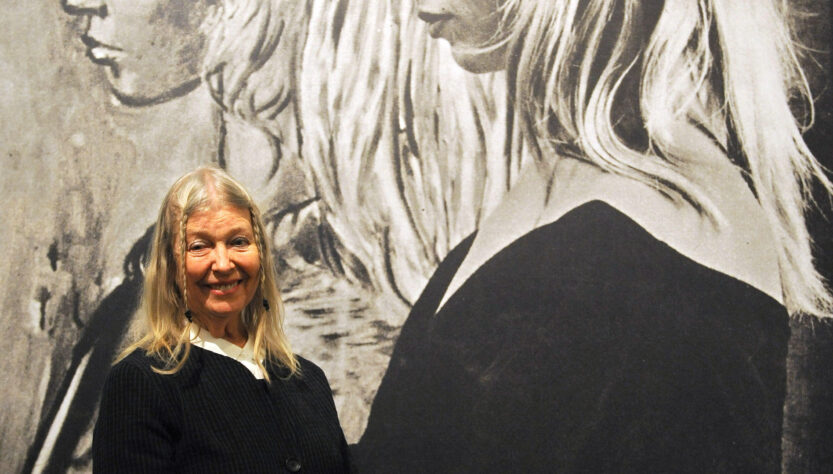
– Meet the wonderful Lydia Corbett, a French Artist living in Devon, still painting in her 80’s.
Today was one of those days where an interview grabbed my attention with both hands. (Thanks to John Acres and his Radio Devon interview this morning).
So with much interest – I replayed the interview twice to listen to the unfolding story of Lydia Corbett – a wonderful softly spoken artist with soft French lilt – and her life from the 1950’s.
Tonight Lydia is speaking about her new book , on “Ceramics, Painter and Sculptor in Clay”, written by Lucien Berman, at Dartington Hall, near her South Brent home.
Lydia the Artist is better known as Sylvette David, the fascination of Spanish painter Pablo Picasso in her younger days. And at just 19, Sylvette was the muse of Picasso for six months in 1953/54.
A discovery in France .
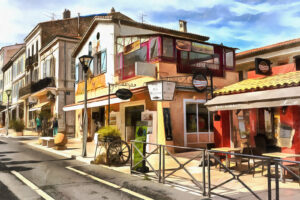
Picture France in the 1950’s; quiet villages, potters, bright sunshine and artists painting in studios with lofty ceilings and large open windows. Well that has Lydia’s – or shall we say -Sylvette’s world.
Unbeknown to Sylvette, she was living her life under Picasso’s artistic gaze.
He started painting Sylvette at a distance as she went about her work making pots in the sunshine of the French Town of Vallauris. Everyday Picasso saw this mysterious girl walk past his studio and painted her from memory. Until one day a picture was posted over the wall of the terrasse Sylvette shared with her partner Toby. The girl with the high pony tail – Sylvette knew it was a likeness of herself – and so the friendship grew.
Sylvette joked she couldn’t see who had posted the picture as they were too small. Indeed Picasso was only 5 ft 3, against Sylvette’s tall and slender shape.
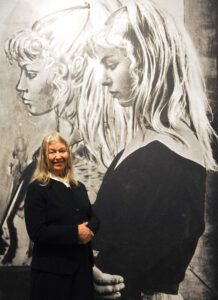
She became Picasso’s muse and fascination and for six months the artist turned out prolific levels of art, showcasing the same blonde, blued girl with high pony tail in varying levels of abstract painting . Sylvette never accepted money for sitting for Picasso.
Pablo Picasso exhibited some 60 works featuring this mysterious girl with a signature high ponytail. Of course that mysterious girl with the unusual hair style was Sylvette.
In the 1950’s Picasso was top of the pile in the Art World and also famous for his string of muses, two wives, his mistresses and his lovers. Picasso was 73 when he met 19 year old Sylvette and she sat for him . A quiet and shy girl, Sylvette was never more than a model for artist interest and painting and saw Picasso more as a fun , father figure.
Brigitte Bardot was said to have approached Picasso a year or so later, with the same high pony hairstyle. Famously he declined her request to paint her, saying he had already painted Sylvette.
Latterly the artist gifted one of his pieces to Sylvette . She chose the painting that looked the most like herself. And so the painting was kept in a gallery in Cannes. Sylvette eventually sold it to an American buyer for £10,000. The sale helped fund a small flat purchase in Paris for Sylvette and Toby, who was recovering from TB.
Today it may be worth £100 million , but Sylvette has no regrets about how things turned out.
Aged 36, Sylvette changed her name to Lydia after following spiritual teachings. Latterly Toby left Lydia for one of her friends and Lydia was alone. Eventually she met and married Rawden Corbett and moved to Devon, where Rawden was vice-principal of Dartington Hall School.
 Picasso died in 1973
It wasn’t until Lydia was 45, divorced for the second time , that she started to paint and develop her own style. She kept her second husband’s surname, Corbett. Not only was she the daughter of an impressionist painter, but Lydia also had Picasso for inspiration. Today, even in her late 80’s, Lydia continues to paint despite her failing eyesight. Her style mixes people, still-life, religion and nature in her artwork with changing scale and perspectives .
And a look around her Gallery and Artworks shows Picasso’s style of influence in the vibrant work she produces to this day.
Lydia still speaks fondly of Picasso to this day, saying he opened up many doors throughout her life.